Showing posts with label art. Show all posts

Tuesday, March 29, 2011

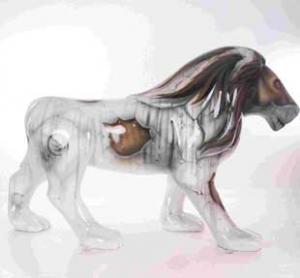
Big cat Kamien the newest addition to Pride in Bournemouth

Big cat Kamien the newest addition to Pride in Bournemouth
3:00pm Saturday 26th March 2011

ARTIST Adam Klodzinski is the latest to make his mark on the Pride in Bournemouth public art event.

Known as Soap, Adam was commissioned by Westbourne gallery Metropolis Art to paint Kamien, its life-size lion statue.

Kamien will be one of at least 50 large lion statues to be displayed across Bournemouth this summer.

All will be auctioned off at the end of the event and the proceeds split between charities Julia’s House and the Born Free Foundation.

“As soon as we learned what the project was about, we signed up,” said gallery co-owner Vicki Angus.

“Adam has captured the majesty of the beast beautifully.

http://www.bournemouthecho.co.uk/news/8924022.Big_cat_Kamien_the_newest_addition_to_Pride_in_Bournemouth/

Tuesday, February 15, 2011

The Mentally Ill Toys of Martin Kittsteiner

By Spooky on September 13th, 2010

A German toymaker has designed a series of cuddly toys, each suffering from serious mental illnesses like depression and hallucination.

36-year-old Martin Kittsteiner, from Hamburg, says the idea to create the bizarre toys started from a joke between him and his girlfriend, who has a lot of stuffed toys, but he soon started to see the potential of the idea.

Each of his cuddly toys has its own disease and symptoms, and comes with a medical history, referral letter and treatment plan. Martin hopes his unique creations will help families with children suffering from mental illnesses.

You can order your very own mentally ill toy from Martin Kittsteiner’s website, for $40 each. There, you can also play a mini-game and try to diagnose the toys’ problems.

More at: http://www.odditycentral.com/pics/the-mentally-ill-toys-of-martin-kittsteiner.html
(Submitted by Richard Freeman)

Chuckie’s friends


Now these are some dolls I wouldn’t recommend any parent to buy for his kids, unless they want them to become really twisted human beings. Come to think of it some of these puppets are even spookier than old Chucky, which in my opinion wasn’t really all that scary. These “toys” on the other hand are much more spookier, darker…scarier!

I wouldn’t be surprised if the person behind these abominations is also behind the disturbing art I posted about not long ago. Anyway the guy clearly has issues!

More at: http://www.odditycentral.com/pics/chuckies-friends.html

Monday, February 14, 2011

William S. Burroughs' Preserved Poop Inspires 'Bio-Art' Piece

Feb 11, 2011 – 3:16 PM
David Moye

Controversial 20th-century novelist William S. Burroughs was best known for his novel "Naked Lunch," and now two "bio-artists" are hoping to turn the remains of his last lunches into art.

Adam Zaretsky and Tony Allard are the creators of "Mutate or Die: A W.S. Burroughs Biotechnical Bestiary," an ongoing project that basically turns a piece of Burroughs' poop into a piece of art.

Burroughs died in 1997 at the age of 83 in Lawrence, Kan., and the poop being used belongs to a family friend and is covered in epoxy, presumably until it could be used for a higher purpose such as this.


Artists Adam Zaretsky and Tony Allard are creating an art piece using a piece of poop that was once in the colon of controversial writer William S. Burroughs.
Courtesy Adam Zaretsky
Artists Adam Zaretsky and Tony Allard are creating an art piece using a piece of poop that was once in the colon of controversial writer William S. Burroughs.
Zaretsky, who has a background in biotech, and Allard, a college professor in San Diego, say their plan is to "take a glob" of the preserved poop, isolate the DNA and make lots of copies of it.

After that, they will soak the DNA dust in gold dust and load it into a "gene gun," a modified air pistol used to insert DNA into plants, worms, rats and humans for experiments.

The DNA dust collected from the poop will be loaded into the pistol, which will then be shot into a mix of blood, poop and semen and then, according to the artists, be declared either a "living bio-art," a "new media print," a "living cut-up literary device" or a mutant sculpture.

Allard admits the concept is, for many people, like poop itself: not easy to grasp even if you're fully aware of its purpose.

"The main response we get from people is, 'Are you serious?' " he told AOL News. "But this is not your typical art project. We see this as a paradigm shift from representational art, since, in this case, the art is in the living organism."

The idea for turning Burroughs' poop into art dates back to October 1996, when Allard was living in Kansas City, Mo., and tried to get the author's DNA sequenced at the scanning electron microscope at the University of Missouri at Kansas City.

That didn't happen, but Allard was able to make things happen after he met Zaretsky at a symposium.

"He asked me what I could do with [Burroughs'] s--t," Zaretsky said. "I told him we could isolate and amplify the DNA from the turd and make a bucket of DNA, and I could throw it in his face.

"But, I also mentioned that if we could raise some money for a gene gun, I could shoot the genes into his balls. After some fundraising, I think we have ourselves a potential to go on a gonad bender."

Allard believes this attempt to make what he calls a "transgenic mutation" fits in better with the spirit of Burroughs' work than the original plan. It also has the complete approval of Burroughs' estate.

"One of Burroughs' most famous quotes is 'Mutate or die!' and mutants run through his work," Allard said.

So do bodily fluids. The mixing of Burroughs' poop and DNA with blood and semen belonging to others is meant to be sort of a shout-out to the author's pioneering "cut-up" technique of writing, in which he cut random book pages in half and mismatched them with other pages.
And the fact that the DNA is being shot with a gun is also an allusion to the 1951 incident when Burroughs shot and killed his wife while playing a drunken game of "William Tell."

But Allard says just the fact they are doing this with DNA is what is truly Burroughsian about the project.

"In the scientific community, transgenic mutations are common," he said. "A piece of corn might have the gene of a flounder to keep it drought-resistant. However, there are controls. It's normalized.

Allard says the randomness of this project flushes that notion down the toilet.

"The exact sciences are obsessed with tight controls over random factors," he said. "They don't do things like this just to see what will happen, but this is what we're interested in. Burroughs was opposed to any kind of control system. He believed in diversity through mutation, which is what this is."

Although Allard and Zaretsky have joked that the combination of blood, sperm and poop could somehow create a race of Burroughs-bred turd monsters, Allard is quick to point out that the amount of the writer's DNA in the poop is actually small.

"The amount of DNA in the s--t is fairly minuscule; it's more like the DNA of what was in his gut at the time," he said.

But the reaction to the project has been robust in just the few days since they announced it -- and that reaction is the first part of what they expect to be a two- to three-year project.

"The first part is announcing the project and having the public comment on it, but we probably won't extract the DNA sample until the fall," he said. "We're creating a context for a dialog.

"In most cases, s--t is an ending point. Here, it's a starting point."

http://www.aolnews.com/discuss/2011/02/11/william-s-burroughs-preserved-poop-inspires-bio-art-piece
Thursday, January 20, 2011

Something in the water: Gerard Byrne goes after the Loch Ness Monster in Milton Keynes

By Mark Sheerin | 13 January 2011

Exhibition: Gerard Byrne - Case Study: Loch Ness (Some possibilities and problems), 2001-2011, Milton Keynes Gallery, Milton Keynes, January 14 - April 3 2011

Unlike most investigations of Loch Ness, Gerard Byrne’s new show is not at all interested in the existence of a monster. His first major solo exhibition in a UK public space is about Nessie as a photographic phenomenon rather than a flesh and bone saurian.

Speaking via phone, the Dublin-based artist explains that what piqued his interest in the place was its relation to the history of photography. "As a site it amounted to a kind of cardinal point, you might say, in the way of people's expectations of photographs, people's beliefs in photography as such,” he says. “Do you know what I mean?”

Byrne has a knack of firing this short question back throughout the interview, usually after making one of his more abstract points. It is a worry because he asks it like he expects an answer.

“Now, I'm not a puritan or a fetishist or anything like that but I'm interested in the idea of photographs as a type of material as well, as a type of material that's generated through certain processes - both optical and chemical - and so it sort of matters that they're analogue prints [in the show] and it sort of matters that they've been generated through this, you know, physical temporal commitment to that site, if you know what I mean.”

By way of comment on the many famous pictures which claim to show what may or may not be in the local waters, Byrne has spent 10 years making a collection of his own photos of Loch Ness.

“There are people who've actually lived in caravans up there and camped out. I haven't done that. But I've made a lot of visits at least - I'd say at least a dozen visits, each for, like, a few days at a time, so I've put in some time up there,” he says.

And as you might expect from a visual artist, Byrne sets the scene very well. “Firstly the loch is very, very big,” he says. “It's much bigger than you might imagine. It's quite epic in scale and it's actually not the most beautiful part of the Highlands, the most, you know, windswept or romantic.”

To the ears of an ignorant southerner this is almost disappointing, until he adds: “It is a little bit dark you might say. I don't want to be melodramatic, but it is a little bit dour and dark in comparison with the surrounding landscape…it's sort of sombre, you might say.”

Byrne’s engagement with this figurative scenery was not without its ironies. “I go there and I make a lot of photographs and I look at the photographs after the fact and I realise that they're all landscape photographs,” says the conceptual artist.

“There's a type of topography at work in the photographs,” he says. "But in the end what they really chronicle is, I think, an idea of forms which could be mistaken for other forms.”

In other words there’s a now-you-see-it-now-you-don’t quality to the work on display, monsters at which you have to look twice.

“That's one of the ideas that's very visible when you see the show - you know, this idea of the gestalt form, this idea of something that's almost in the mind's eye,” he adds.

It is, after all, such gestalt forms which give rise to lake-dwelling monsters. “That’s a kind of archeptypal myth that's found all around the world, and what distinguishes Loch Ness from the rest is precisely its mediation in the newspaper,” says Byrne.

He goes on to explain that interest in Loch Ness peaked in the early 1930s, at a time when the mass media was becoming all pervasive and more people were becoming aware of a sense of modernity.

“It's interesting that there's so much attraction to a myth that's primarily about the primeval, that's about the idea of something from prehistory, that could continue to live in the 20th century or the 21st century,” he says. “So there's a strange fantasy built into that that's about time or about escaping time or something that defies time.”

In which case new town Milton Keynes is the last place you’d expect to find a mythical dinosaur. But now that is where you will find it, as large as life - an indisputable phenomena if nothing else.

Open 12pm-8pm Tuesday-Friday (from 11am Saturday, 11am-5pm Sunday). Admission free.

http://www.culture24.org.uk/art/photography+%26+film/art315825

Something in the water: Gerard Byrne goes after the Loch Ness Monster in Milton Keynes

By Mark Sheerin | 13 January 2011

Exhibition: Gerard Byrne - Case Study: Loch Ness (Some possibilities and problems), 2001-2011, Milton Keynes Gallery, Milton Keynes, January 14 - April 3 2011

Unlike most investigations of Loch Ness, Gerard Byrne’s new show is not at all interested in the existence of a monster. His first major solo exhibition in a UK public space is about Nessie as a photographic phenomenon rather than a flesh and bone saurian.

Speaking via phone, the Dublin-based artist explains that what piqued his interest in the place was its relation to the history of photography. "As a site it amounted to a kind of cardinal point, you might say, in the way of people's expectations of photographs, people's beliefs in photography as such,” he says. “Do you know what I mean?”

Byrne has a knack of firing this short question back throughout the interview, usually after making one of his more abstract points. It is a worry because he asks it like he expects an answer.

“Now, I'm not a puritan or a fetishist or anything like that but I'm interested in the idea of photographs as a type of material as well, as a type of material that's generated through certain processes - both optical and chemical - and so it sort of matters that they're analogue prints [in the show] and it sort of matters that they've been generated through this, you know, physical temporal commitment to that site, if you know what I mean.”

By way of comment on the many famous pictures which claim to show what may or may not be in the local waters, Byrne has spent 10 years making a collection of his own photos of Loch Ness.

“There are people who've actually lived in caravans up there and camped out. I haven't done that. But I've made a lot of visits at least - I'd say at least a dozen visits, each for, like, a few days at a time, so I've put in some time up there,” he says.

And as you might expect from a visual artist, Byrne sets the scene very well. “Firstly the loch is very, very big,” he says. “It's much bigger than you might imagine. It's quite epic in scale and it's actually not the most beautiful part of the Highlands, the most, you know, windswept or romantic.”

To the ears of an ignorant southerner this is almost disappointing, until he adds: “It is a little bit dark you might say. I don't want to be melodramatic, but it is a little bit dour and dark in comparison with the surrounding landscape…it's sort of sombre, you might say.”

Byrne’s engagement with this figurative scenery was not without its ironies. “I go there and I make a lot of photographs and I look at the photographs after the fact and I realise that they're all landscape photographs,” says the conceptual artist.

“There's a type of topography at work in the photographs,” he says. "But in the end what they really chronicle is, I think, an idea of forms which could be mistaken for other forms.”

In other words there’s a now-you-see-it-now-you-don’t quality to the work on display, monsters at which you have to look twice.

“That's one of the ideas that's very visible when you see the show - you know, this idea of the gestalt form, this idea of something that's almost in the mind's eye,” he adds.

It is, after all, such gestalt forms which give rise to lake-dwelling monsters. “That’s a kind of archeptypal myth that's found all around the world, and what distinguishes Loch Ness from the rest is precisely its mediation in the newspaper,” says Byrne.

He goes on to explain that interest in Loch Ness peaked in the early 1930s, at a time when the mass media was becoming all pervasive and more people were becoming aware of a sense of modernity.

“It's interesting that there's so much attraction to a myth that's primarily about the primeval, that's about the idea of something from prehistory, that could continue to live in the 20th century or the 21st century,” he says. “So there's a strange fantasy built into that that's about time or about escaping time or something that defies time.”

In which case new town Milton Keynes is the last place you’d expect to find a mythical dinosaur. But now that is where you will find it, as large as life - an indisputable phenomena if nothing else.

Open 12pm-8pm Tuesday-Friday (from 11am Saturday, 11am-5pm Sunday). Admission free.

http://www.culture24.org.uk/art/photography+%26+film/art315825

Wednesday, August 11, 2010

Odd dream about flying pet pig inspires Nessie Project member's followup for ArtPrize 2010

RIGHT: A smaller mockup of the SteamPig for ArtPrize. The sculpture will be a 55-foot-long, 25-foot-high and 25-foot wide and made of the same foam that made up Nessie's body.
Tuesday, August 10, 2010, 5:57 AM
Rachael Recker | The Grand Rapids Press

GRAND RAPIDS -- Thomas Birks, a member of the Nessie Project team, remembers what could have been his first clue for his ArtPrize 2010 entry.

Birks would bring Cecilia, his potbelly pig, to visit his art deco Loch Ness monster, "Nessie on the Grand," that was a popular attraction in the Grand River during last year's arts competition.

"All of a sudden, the attention would come off Nessie and be on the pig," said Birks.

Nessie last year took sixth place and won $7,000.

Thanks to 2-year-old Cecilia, and what vivid dreams may come from owning such a pet, Birks conceived his ArtPrize 2010 entry, titled "Parcifal, The SteamPig," which is part floating ship, part flying machine, in the body of a pig.

Birks dreamt about his pet pig one night, flying and doing laps around the kitchen as she was strapped into a harness with Da Vinci-like wings.

"What was peculiar about it was that she seemed so happy and proud," Birks said.

Joachim Jensen, one of the other four Nessie Project team members, was sold on the dream. The two are embarking on what will be a smaller but more complicated and detailed sculpture than Nessie.

"This is going to be a bigger job, I think. I would say it's about three times the work," Jensen said. "I have a feeling I'm going to be at least as excited about this as Nessie."

The SteamPig pays homage to, well, Cecilia, even though the face resembles an Indonesian boar. But it also tips a hat to Grand Rapids' history in machinations, such as steam engines, as well as the Steampunk art movement popularized in the '80s.

Parsifal was named after a wandering knight of King Arthur's round table and the subject of Wagner's opera. It now has its own myth that can be read at steampig.com. It will be a 55-foot-long, 25-foot-high and 25-foot wide sculpture made of the same foam that made up Nessie's body.

The sculpture will weigh between 7,000 and 8,000 pounds, and contain about 60 pieces and 1,500 rivets. Jensen believes it ultimately will cost "a lot more" than Nessie -- more than $100,000.

The piece, which will be displayed in the parking lot of The B.O.B. facing Van Andel Arena, will be raised about 10 feet off the ground to dissuade the curious from climbing on it. ArtPrize attendees will be able to walk underneath it and stare into its lighted ribcage, displaying the wheels and machinations of a steam engine.

Painter Michael Knoll of Michael Knoll Paint and Design, will be painting the "earthy, old and dirty" colors of what's supposed to be a more than 100-year-old flying pig. Knoll also painted Nessie.

Work began last weekend on the actual sculpture at a downtown warehouse. Jensen looked anxious, but excited.

Said Jensen with a grin: "The chainsaws are sharp. They're ready to go."

http://www.mlive.com/artprize/index.ssf/2010/08/odd_dream_about_flying_pet_pig_inspires_nessie_project_members_followup_for_artprize_2010.html

Wednesday, June 30, 2010

Students: can we have our bum slapping lucky cow back, please?

It’s a case of moo done it after a lucky statue of a cow was stolen from a college in Vienna days before their final exams.

The design students have begged police to find the life-size plastic cow, believing it brings good luck to anyone who slaps its rump before an exam.

The cow, decorated with Hawaiian flowers, was stolen from the school overnight.

The cow was one of the CowParade creations created by students for part of the largest and most successful public art event in the world.

Students now hope that tips leading to the thief will come forward after initiating a city-wide 'Wanted: Our School Cow' campaign.

http://www.metro.co.uk/weird/833486-students-can-we-have-our-bum-slapping-lucky-cow-back-please

Sunday, March 28, 2010

Nessie in Italian attic mystery

Mystery drawing may have been done by master illusionist

By neil macphail
Published: 13/03/2010

Our Loch Ness Monster is famed the world over, and pops up in very strange circumstances from time to time.

Now she has surfaced at the centre of an art mystery in Italy.

This centres around a charcoal drawing dating from 1949, which is described as Loch Ness Monster and Black Man without a Face, and which could possibly have been drawn by famous Dutch artist, MC Escher.

This story of the mystery painting starts in 2005 in Volturara, a small village in the Italian province of Avellino, where traffic police officer Raffaele De Feo lives.

When clearing out his family’s attic, he found what he called “the strange picture”.

Initially he did not take any notice of it, but later, in removing the frame, he sees an inscription on the back of the picture, signed by MC Escher, which reads: “With all my heart to a friendly remembrance.”

Now some Italians are urging art experts to authenticate the work as being done by Maurits Cornelis Escher, nicknamed “Mauk", and contacted the Press and Journal to spread the world that Nessie “lives” in Italy.

Escher (1898-1972) was hailed by many as one of the world's most famous graphic artists. His art is enjoyed by millions of people all over the world, as can be seen on the many web sites on the internet. And for several years he lived and travelled in Italy.

He is most famous for his so-called impossible structures, such as Ascending and Descending, Relativity, his Transformation Prints, such as Metamorphosis I, Metamorphosis II and Metamorphosis III, Sky & Water I or Reptiles.

http://www.pressandjournal.co.uk/Article.aspx/1645086?UserKey=#ixzz0jUKgoNYg

Sunday, March 14, 2010

Poet Philip Larkin's death marked with giant toads

In a novel way to commemorate the 25th anniversary of the death of the poet Philip Larkin, a council is to spend £200,000 on 65 giant fibreglass toads.

By Andrew Alderson
Published: 8:32PM GMT 13 Mar 2010

The oversized amphibians will be displayed at locations around Hull for 10 weeks later this year. According to Hull City Council documents, "This project is designed to spark interest in Larkin's poetry among people who are made curious by the unexpected presence of their local 'toad'."

The move is intended to honour Larkin's two poems, Toads and Toads Revisited. Civil leaders hope it will create interest in Larkin's poetry and boost the profile of the city where he lived for 30 years.

But an MP has accused the Lib Dem-controlled council of wasting funds. Diana Johnson, Labour MP for North Hull, said: "You couldn't make this up. This is a scandalous misuse of taxpayers' money, especially in these harsh economic times."

Defending the project, Lib Dem Councillor Rick Welton, cabinet member for regeneration, said the toads would attract visitors and publicity to the city, bringing in extra investment, and would also be used in schools to promoting poetry and literature.

He said: "Instead of looking at the negatives, I believe there are going to be a lot of positives from this."

The project, called Plague of Toads, will cost £292,000 in total, with the rest of the funding coming from other sources. Council documents state: "Businesses, institutions, community organisations and artists will be invited to take part in workshops and to decorate their toad in individual livery to be placed in an appropriate location."

An entire programme of events to commemorate the anniversary, called Larkin 25, will cost £713,000. Among its elements will be the commissioning of a life-size statue of Larkin to sited at Hull's Paragon Station.

The poet completed many of his most important works while working as a librarian at Hull University.

http://www.telegraph.co.uk/news/newstopics/howaboutthat/7437587/Poet-Philip-Larkins-death-marked-with-giant-toads.html