5 October 2010
By Megan Lane BBC News Magazine
The plight of the disappearing red squirrel is being highlighted in events dedicated to the native British species. But its tormenter, the American grey squirrel, is itself being slowly overwhelmed in parts of the country by the little-known black squirrel.
When Alison Thomas first saw a black squirrel dart in front of her car, she nearly swerved off the road in surprise. That was in July 2003, and as a biologist, she found this strange creature a beguiling research topic - not least to disprove the family joke that she'd imagined it.
"I decided to start my own investigations and discovered, to my great relief and to the chagrin of my family, that squirrels can indeed sometimes be black and that there is a rapidly expanding population of black squirrels in Cambridgeshire," says Dr Thomas, of Anglia Ruskin University in Cambridge.
The black squirrel is of the same species as the grey bushy-tailed creatures familiar from park and woodland walks. Its dark coat is the result of a naturally occurring mutation of the gene that governs fur pigmentation.
Other than colour, black squirrels have the same size, behaviour and habitat as greys.
"It's the same specific mutation found in the black squirrels of North America. The chances of that same mutation occurring by chance in the UK, and separately in the United States, is tiny.
"This shows that at some point, black squirrels were brought into this country from North America."
The first recorded sighting of a black squirrel was in 1912 on the outskirts of Letchworth. It's thought that, like grey squirrels, a handful of black-furred specimens were imported for a private zoo and then escaped or were released.
"People speculate that it was the Duke of Bedford who imported black squirrels, but I've been unable to confirm that - even with the help of the family's archivists," says Dr Thomas.
It took another 30 years before black squirrels were spotted on the south-west borders of Cambridgeshire.
Today they are found in a ribbon across Hertfordshire, Bedfordshire and Cambridgeshire. In some hot-spots, blacks now outnumber greys, making up an estimated three-quarters of the squirrel population in villages such as Girton in Cambridgeshire.
"They're not found anywhere else in the UK. But people have reported seeing black versions of red squirrels - a different species, remember - on the Isle of Skye," says Dr Thomas.
Amateur photographer Simon George, of Henlow in Bedfordshire, has been documenting the comings and goings of a black squirrel in his back garden for several years.
"We more or less adopted her, and called her Coffee. She would come if you called her and ate out of our hands; she loved Waitrose finest walnuts. She had a litter of six last summer and survived the snow of last winter, but we have not seen her, or any other squirrel, since March."
In his area, too, black squirrels have largely replaced greys - he speculates that this is because they're bigger.
But Dr Thomas says any differences in size or behaviour are probably down to age.
"Blacks and greys are the same species. Any differences people notice are likely to be age-related."
The rise of the black is the biggest change in squirrel demographics since the native reds almost disappeared 50 years ago from large parts of England.
This is not because black squirrels compete with greys in the way that greys compete with reds (the larger greys eat more, and carry a pox that is deadly to reds), but because the gene for black fur is dominant, just like the gene for brown eyes is dominant over blue in humans.
"Two grey squirrels cannot produce black-furred offspring, just as blue-eyed parents cannot have a brown-eyed baby," says Dr Thomas. "You need to have a black-furred parent to produce black offspring."
As wildlife watchers gear up for the Wildlife Trusts' population count for Red Squirrel Week, or for the start of the BBC's Autumnwatch on Thursday, Dr Thomas has a fond hope.
"I'd like there to be a count of how many black squirrels there are now. We're so programmed to expect grey squirrels that it's a shock when you first see a black one - it's startling and interesting."
More at: http://www.bbc.co.uk/news/magazine-11444893
Showing posts with label melanism. Show all posts
Wednesday, October 13, 2010
The slow scamper of the black squirrel
5 October 2010
By Megan Lane BBC News Magazine
The plight of the disappearing red squirrel is being highlighted in events dedicated to the native British species. But its tormenter, the American grey squirrel, is itself being slowly overwhelmed in parts of the country by the little-known black squirrel.
When Alison Thomas first saw a black squirrel dart in front of her car, she nearly swerved off the road in surprise. That was in July 2003, and as a biologist, she found this strange creature a beguiling research topic - not least to disprove the family joke that she'd imagined it.
"I decided to start my own investigations and discovered, to my great relief and to the chagrin of my family, that squirrels can indeed sometimes be black and that there is a rapidly expanding population of black squirrels in Cambridgeshire," says Dr Thomas, of Anglia Ruskin University in Cambridge.
The black squirrel is of the same species as the grey bushy-tailed creatures familiar from park and woodland walks. Its dark coat is the result of a naturally occurring mutation of the gene that governs fur pigmentation.
Other than colour, black squirrels have the same size, behaviour and habitat as greys.
"It's the same specific mutation found in the black squirrels of North America. The chances of that same mutation occurring by chance in the UK, and separately in the United States, is tiny.
"This shows that at some point, black squirrels were brought into this country from North America."
The first recorded sighting of a black squirrel was in 1912 on the outskirts of Letchworth. It's thought that, like grey squirrels, a handful of black-furred specimens were imported for a private zoo and then escaped or were released.
"People speculate that it was the Duke of Bedford who imported black squirrels, but I've been unable to confirm that - even with the help of the family's archivists," says Dr Thomas.
It took another 30 years before black squirrels were spotted on the south-west borders of Cambridgeshire.
Today they are found in a ribbon across Hertfordshire, Bedfordshire and Cambridgeshire. In some hot-spots, blacks now outnumber greys, making up an estimated three-quarters of the squirrel population in villages such as Girton in Cambridgeshire.
"They're not found anywhere else in the UK. But people have reported seeing black versions of red squirrels - a different species, remember - on the Isle of Skye," says Dr Thomas.
Amateur photographer Simon George, of Henlow in Bedfordshire, has been documenting the comings and goings of a black squirrel in his back garden for several years.
"We more or less adopted her, and called her Coffee. She would come if you called her and ate out of our hands; she loved Waitrose finest walnuts. She had a litter of six last summer and survived the snow of last winter, but we have not seen her, or any other squirrel, since March."
In his area, too, black squirrels have largely replaced greys - he speculates that this is because they're bigger.
But Dr Thomas says any differences in size or behaviour are probably down to age.
"Blacks and greys are the same species. Any differences people notice are likely to be age-related."
The rise of the black is the biggest change in squirrel demographics since the native reds almost disappeared 50 years ago from large parts of England.
This is not because black squirrels compete with greys in the way that greys compete with reds (the larger greys eat more, and carry a pox that is deadly to reds), but because the gene for black fur is dominant, just like the gene for brown eyes is dominant over blue in humans.
"Two grey squirrels cannot produce black-furred offspring, just as blue-eyed parents cannot have a brown-eyed baby," says Dr Thomas. "You need to have a black-furred parent to produce black offspring."
As wildlife watchers gear up for the Wildlife Trusts' population count for Red Squirrel Week, or for the start of the BBC's Autumnwatch on Thursday, Dr Thomas has a fond hope.
"I'd like there to be a count of how many black squirrels there are now. We're so programmed to expect grey squirrels that it's a shock when you first see a black one - it's startling and interesting."
More at: http://www.bbc.co.uk/news/magazine-11444893
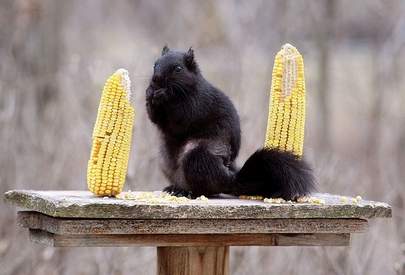
By Megan Lane BBC News Magazine
The plight of the disappearing red squirrel is being highlighted in events dedicated to the native British species. But its tormenter, the American grey squirrel, is itself being slowly overwhelmed in parts of the country by the little-known black squirrel.
When Alison Thomas first saw a black squirrel dart in front of her car, she nearly swerved off the road in surprise. That was in July 2003, and as a biologist, she found this strange creature a beguiling research topic - not least to disprove the family joke that she'd imagined it.
"I decided to start my own investigations and discovered, to my great relief and to the chagrin of my family, that squirrels can indeed sometimes be black and that there is a rapidly expanding population of black squirrels in Cambridgeshire," says Dr Thomas, of Anglia Ruskin University in Cambridge.
The black squirrel is of the same species as the grey bushy-tailed creatures familiar from park and woodland walks. Its dark coat is the result of a naturally occurring mutation of the gene that governs fur pigmentation.
Other than colour, black squirrels have the same size, behaviour and habitat as greys.
"It's the same specific mutation found in the black squirrels of North America. The chances of that same mutation occurring by chance in the UK, and separately in the United States, is tiny.
"This shows that at some point, black squirrels were brought into this country from North America."
The first recorded sighting of a black squirrel was in 1912 on the outskirts of Letchworth. It's thought that, like grey squirrels, a handful of black-furred specimens were imported for a private zoo and then escaped or were released.
"People speculate that it was the Duke of Bedford who imported black squirrels, but I've been unable to confirm that - even with the help of the family's archivists," says Dr Thomas.
It took another 30 years before black squirrels were spotted on the south-west borders of Cambridgeshire.
Today they are found in a ribbon across Hertfordshire, Bedfordshire and Cambridgeshire. In some hot-spots, blacks now outnumber greys, making up an estimated three-quarters of the squirrel population in villages such as Girton in Cambridgeshire.
"They're not found anywhere else in the UK. But people have reported seeing black versions of red squirrels - a different species, remember - on the Isle of Skye," says Dr Thomas.
Amateur photographer Simon George, of Henlow in Bedfordshire, has been documenting the comings and goings of a black squirrel in his back garden for several years.
"We more or less adopted her, and called her Coffee. She would come if you called her and ate out of our hands; she loved Waitrose finest walnuts. She had a litter of six last summer and survived the snow of last winter, but we have not seen her, or any other squirrel, since March."
In his area, too, black squirrels have largely replaced greys - he speculates that this is because they're bigger.
But Dr Thomas says any differences in size or behaviour are probably down to age.
"Blacks and greys are the same species. Any differences people notice are likely to be age-related."
The rise of the black is the biggest change in squirrel demographics since the native reds almost disappeared 50 years ago from large parts of England.
This is not because black squirrels compete with greys in the way that greys compete with reds (the larger greys eat more, and carry a pox that is deadly to reds), but because the gene for black fur is dominant, just like the gene for brown eyes is dominant over blue in humans.
"Two grey squirrels cannot produce black-furred offspring, just as blue-eyed parents cannot have a brown-eyed baby," says Dr Thomas. "You need to have a black-furred parent to produce black offspring."
As wildlife watchers gear up for the Wildlife Trusts' population count for Red Squirrel Week, or for the start of the BBC's Autumnwatch on Thursday, Dr Thomas has a fond hope.
"I'd like there to be a count of how many black squirrels there are now. We're so programmed to expect grey squirrels that it's a shock when you first see a black one - it's startling and interesting."
More at: http://www.bbc.co.uk/news/magazine-11444893
Monday, March 29, 2010
Don't fear the bald squirrels

RIGHT: A black squirrel snacks at a feeder at the residence of Diane and Leonard Johnson on Morningside Avenue in Council Bluffs Wednesday. The squirrel, and several others in the area, suffers from mange, a skin disease caused by the infestation of tiny mites. The result is bare spots in a squirrel’s fur, visible around this animal’s legs.Published Thursday March 25, 2010
CINDY CHRISTENSEN/WORLD-HERALD NEWS SERVICE.
By Tim Rohwer
WORLD-HERALD NEWS SERVICE
COUNCIL BLUFFS -- If people see squirrels with little or no fur, they shouldn’t be alarmed, according to Council Bluffs Public Works Director Donn Dierks.
“It’s an every-year occurrence,” he said.
A Council Bluffs couple expressed concern that squirrels seen in their yard may have contracted a contagious disease because the animals have patches of fur missing.
“It seems to be spreading from squirrel to squirrel,” said Diane Johnson, who lives with her husband, Leonard, on Morningside Avenue.
One squirrel had no fur at all, she said.
“It looked so awful,” Johnson said. “I felt sorry for the squirrel.”
According to Dierks, these squirrels have mange, a skin disease of mammals caused by the infestation of tiny mites.
“In extreme cases, the entire body can become bare of hair and expose the skin that can become dark,” he said. “Full recovery, however, occurs in squirrels. At this point in time, we’ll leave it up to nature to handle the problem.”
There is a way to treat the diseased squirrels, Dierks said, but it’s not cost-effective for the city to trap them for treatment.
“We just don’t have the finances to do that.”
People shouldn’t try to do it on their own, he advised.
Residents are not allowed to trap animals, he said. And “there shouldn’t be any direct contact between a squirrel and a human,” Dierks said.
There are several types of mites, he said, with one known to transfer from animal hosts to people, though there has to be physical contact between the animal and the person.
Squirrel mange should not be a danger to pets.
“Mange is pretty species-specific, so it shouldn’t be a problem if it’s going around the squirrels, “ said Dr. Emily Buhr of the Animal Emergency Clinic in Omaha. “They tend to stick with the species they are with ... A dog can’t go up to a squirrel and get squirrel mange.”
But the malady, at least in squirrels, is common, she said.
“I’ve seen a lot of them that have had issues with it,” Buhr said. ‘I think it tends to happen in the winter, when they probably get a little bit immune-suppressed.”
If someone should need to handle a mangy animal, Dierks said, it’s best to wear rubber gloves and wash properly afterward.
World-Herald staff writer Andrew J. Nelson contributed to this report.
http://www.omaha.com/article/20100325/NEWS01/703259819
Subscribe to:
Posts (Atom)
