Only hillbilly hunters have ever seen one alive
Vietnam is to set up a nature reserve for unfeasibly rare – possibly now extinct – two-horned "unicorns".
No more unicorn hunting. By order
The creature in question is more formally known as the saola. It is informally referred to as being unicorn-like for its extreme rarity: no scientist has ever seen a live saola and its existence was only confirmed some 20 years ago. In some circles the saola is thought to be responsible for Chinese legends regarding the qilin, a fantastical
creature equivalent to the unicorn in European lore.
The last saola encounter took place last year, when a single male was captured by Laotian villagers. Unfortunately the creature died before government scientists could intervene.
Prior to that occurrence, the last confirmation of the saola's existence came in 1999, when automatic camera traps recorded the elusive creatures in their sole habitat – the dense high forests of the Annamite (Truong Son) Mountains along the Laos/Vietnam border, where once the People's Army of Vietnam* marched along the Ho Chi Minh Trail to war against the Americans.
Now the Vietnamese authorities say they will institute a 60 square mile sanctuary for the saola in the forests of Quang Nam province, along the Laotian border. Measures will be put in place to stop the local mountaineer villagers hunting the rare creatures. The hill folk are often of different ethnic background to the main Vietnamese
population, and relations between them and the government haven't always been entirely cordial.
"For ethnic minority people, hunting is a way of earning their living," Quang Nam provincial forestry chief Pham Thanh Lam tells the Associated Press.
"They would not spare the saola, so it's necessary to create conditions for them to earn their living to minimise hunting." This will be done by means of educational programmes and creation of jobs for locals in running the reserve, according to the Vietnamese officials. The local authorities believe that as many as 60 saola may
survive in the high forests, though it is always possible that the one which died last year was the last.
Pic at site:
http://www.theregister.co.uk/2011/04/19/unicorn_sanctuary/
Showing posts with label vu quang ox. Show all posts
Showing posts with label vu quang ox. Show all posts
Wednesday, April 20, 2011

Wednesday, April 6, 2011
The saola: rushing to save the most 'spectacular zoological discovery' of the 20th Century
http://news.mongabay.com/2011/0404-hance_robichaud.html
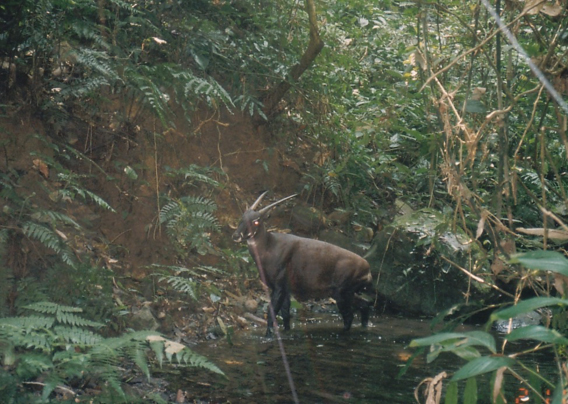 The saola (Pseudoryx nghetinhensis) may be the most enigmatic, beautiful, and endangered big mammal in the world—that no one has ever heard of. The shy ungulate looks like an African antelope—perhaps inhabiting the wide deserts of the Sahara—but instead it lives in the dense jungles of Vietnam and Laos, and is more related to wild cattle than Africa's antelopes. The saola is so unusual that is has been given its own genus: Pseudoryx, due to its superficial similarities to Africa's oryx. In the company of humans this quiet forest dweller acts calm and tame, but has yet to survive captivity long. Yet strangest of all, the 200 pound (90 kilogram) animal remained wholly unknown to science until 1992.
The saola: rushing to save the most 'spectacular zoological discovery' of the 20th Century
mongabay.com
April 04, 2011
The saola (Pseudoryx nghetinhensis) may be the most enigmatic, beautiful, and endangered big mammal in the world—that no one has ever heard of. The shy ungulate looks like an African antelope—perhaps inhabiting the wide deserts of the Sahara—but instead it lives in the dense jungles of Vietnam and Laos, and is more related to wild cattle than Africa's antelopes. The saola is so unusual that is has been given its own genus: Pseudoryx, due to its superficial similarities to Africa's oryx. In the company of humans this quiet forest dweller acts calm and tame, but has yet to survive captivity long. Yet strangest of all, the 200 pound (90 kilogram) animal remained wholly unknown to science until 1992. "[The saola] was perhaps the most spectacular zoological discovery of the 20th century (at least among vertebrates). The only comparable discovery was the okapi of central Africa in 1900. The okapi is like the saola in many ways—a highly distinctive, solitary ungulate dwelling in deep forest, utterly unknown to the outside world until relatively late. But it was found almost a century before saola," explains William Robichaud in an interview with mongabay.com. Robichaud is Coordinator of the Saola Working Group and one of the world's foremost experts on the animal.
"How many other terrestrial species in the world the size of a saola […] have never been seen in the wild by a biologist?" asks Robichaud. "None, surely."
Yet, few mammals in the world are as imperiled as the saola. No one knows whether 100 or 500 survive, but the number isn't high and the population is declining. Having only known of the species for less than 20 years, conservationists have a considerable problem on their hand: they have little time, working with scant information, to save a species that few people have ever heard of.
According to Robichaud the biggest threat to saola is hunting, but the " saola is killed largely as by-catch: a tuna and dolphins scenario." In this case, snares set in the jungle for other species have pushed the saola to the edge of extinction.
"Ironically, saola is one of the only wild Southeast Asian mammals bigger than a squirrel without a significant price on its head," Robichaud explains. "The Chinese never knew saola, and so it does not appear in their traditional pharmacopeia. This offers substantial hope for the animal's conservation. Unlike, say, rhinos, poachers are not racing conservationists to the last saola. "
Conservation projects to save the species are moving forward. A fund has been set up to provide base funding for the next 30 years; WWF-Vietnam is working on training rangers; and the saola was recently named a focal species for the Zoological Society of London's EDGE program, which will give the saola a bigger profile as well as material aid.
In other good news, last year a saola was brought into a local village giving researchers the first material evidence of the saola's survival in over ten years (camera trap photos were taken in 1999). Unfortunately, as with other saolas, the animal quickly perished in captivity.
"It was highly significant for generating renewed interest the animal, and convincing donors and other partners that it still exists," says Robichaud who was fortunate enough to spend time with another captured saola. "We know, from detailed information provided by local villagers (who, incidentally, are more likely to hide information about saola than exaggerate it) that saola are still out there; in other words, it was the first sighting in 10 years by biologists or westerners, but not by villagers."
Saving the saola would also benefit a wide array of endangered and little-known animals, some with evolutionary histories as unique in the saola's. Numerous discoveries over the past couple decades have proven that the saola's stomping ground, the Annamite Mountains, is rich in weird and wild species found no-where else—from a bald songbird to a prehistoric rodent to a striped rabbit.
Robichaud, who has spent decades working in Laos, says that it has been easy to convince local people to save the saola once they realize they safeguard the world's only population.
"They'll commonly ask, 'But doesn't America have lots of saola, or that place we heard about with lots of wild animals, Africa?' When they learn that the answer is no, and that saola isn't found even in neighboring Thailand or China, or even other provinces of Laos, you can see a paradigm shift in their eyes. They begin to become proud of the animal, and the role they can have in its conservation. "
Saving the saola will be an uphill battle: there are none in captivity and only a small population left in the wild; threats are only increasing, as evidenced by the Ho Chi Minh road plans; the animal is little known even in the conservation community; and the impetus across Asia is development at any cost, not conservation for future generations. It wouldn't be surprising in a decade or two to read that the long-unknown saola had vanished into the jungle's shadows for good.
Of course, it doesn’t have to be this way.
"What are we waiting for?" asks Robichaud. "For those wishing to make a significant, incremental contribution to conservation of the earth's biodiversity, among species it is hard to imagine a more compelling focus than saola."
In an April 2011 interview William Robichaud discussed the surprise of the saola's discovery, the threats this species faces, the conservation efforts being put together, and spending time with a saola dubbed 'Martha'.
Plus interview at site
Subscribe to:
Posts (Atom)