Showing posts with label cull. Show all posts

Wednesday, November 16, 2011

Camels 'left to rot' after mass cull

The owner of a Central Australian cattle station is angry that camel carcasses have been left to rot after recent culls.

Ian Conway runs Kings Creek Station near where 5,000 camels have been shot from helicopters in the past fortnight.

Mr Conway has acknowledged that camel numbers need to be cut because of the significant ecological and pastoral damage the animals cause.

But he says previous culls have shown it is cruel to shoot them and leave them to rot.

"We've been along and seen where camels have kicked for 20 minutes, half an hour, a couple of hours in some instances, still alive," he said.

"All that did was increase the population of dingoes around Docker River and blowflies.

"And the stench around the country was unbelievable. I spoke to many Aboriginal men who said they'd left the country because it was too rotten to stay there for up to six months."

Mr Conway says camels should be taken to an abattoir in Caboolture in south-east Queensland for meat rather than left on the ground.

"If they were caught, even if half of them were caught, that's revenue for people in the Territory," he said.

"In Caboolture they'll take as many as we possibly can get. They'll actually send the trucks over to pick them up and pay you at the doorstep - $220 a head."

Northern Territory Chief Minister Paul Henderson says he will investigate the claims.

"That should absolutely be done humanely, and I don't know where those reports are coming from, but we'll certainly look into them," he said.

http://www.abc.net.au/news/2011-11-09/culls-leave-camels-to-rot/3656018

Wednesday, October 5, 2011

Cull 'cannot save' Tasmanian devil


Read on...

Thursday, September 29, 2011

Canada geese, an invasive species soon to be culled

Once a protected species, Canada geese (Branta canadensis) may soon become a target for hunters. There are certainly so many of them in France that they are beginning to pose a threat to wetland biodiversity. On 6 September, the day before the shooting season opened in France, the National Hunters Federation (FNC) repeated its determination to have the geese put back on the list of waterfowl that can be hunted. But is this the right answer?

The Canada goose is the largest goose found in Europe. It was introduced to Britain in the 17th century, then adopted as a game bird on the continent during the last century. In the wild they live 10 to 25 years and are prolific breeders. They are now resident in western Europe and, for reasons that remain obscure, their numbers have started increasing very fast. They are now on a list of 100 invasive species posing a serious threat to biodiversity in Europe.

There were only several hundred Canada geese in France at the end of the 1990s. Now there are more than 5,000 spread over at least 58 départements, with half in the Paris area.

"Unlike other wild geese, the Canada goose is quite happy in the suburbs, in parks, on lakes and in marinas," says ornithologist Philippe Dubois, who is coordinating a national survey of invasive alien species for France's League for the Protection of Birds (LPO). "Their droppings really make a mess on lawns and leisure areas, and in swimming pools." In 2009 the health risk caused by this pollution led to the temporary closure of an outdoor leisure centre at Cergy-Pontoise, north-west of Paris.

If they settle in wilder spots, Canada geese pose other problems. "They have a strong sense of territory and will prevent other waterfowl from moving into quite a large area round their nest, so they may hinder reproduction by ducks, coots and other goose species," Dubois says. He reckons that if the present population dynamic continues, something will have to be done. This would involve a more radical response than the occasional measures taken recently by the National Agency for Hunting and Wildlife (ONCFS), sterilising eggs and culling birds on the orders of the local government representative.

In response to a government request for plans for a campaign, the ONCFS recommended a culling role for hunters. But Pierre Migot, its head, pointed out that many people don't want the geese to disappear and a goal needs to be set. So it remains to be seen what fate awaits the Canada goose in France.
Frédéric Jiguet, an ornithologist at the Muséum d'Histoire Naturelle in Paris, has a compromise. "Maybe they should resume hunting this invasive species," he says. "But in exchange we should take the greylag goose off the game list, at least from August to October." In 2010 there were only 150 pairs left in France.

This article orginally appeared in Le Monde

http://www.guardian.co.uk/environment/2011/sep/27/france-considers-canada-geese-cull?newsfeed=true

Wednesday, August 24, 2011

Wildwood joins the fight to save Britain's badgers from the cull

Wildwood Trust is very disappointed that the Government has given a green light to new proposals to allow landowners to shoot badgers.

Wildwood Trust very much recognises Bovine Tuberculosis (bTB) as a significant problem that causes hardship for many in the farming community, but believes that blaming badgers for bTB is just a scapegoat for the industry to avoid their responsibilities and avoid the cost of bTB control, while at the same time collecting huge subsidies from the taxpayer.

Peter Smith, Wildwood Trust’s Chief Executive stated:

“Wildwood Trust is coming to the defence of badgers as they are used as a scapegoat by an industrial farming lobby determined to hide poor farming practices, cruelty, massive taxpayer hand-outs, fraud and illegal practices that could end up in serious consequences for the British public.

The badger debate has been around for a very long time, over 40 years, but behind the simplistic headlines that badger lovers and farmers are at loggerheads is a much more complex and subtle story, a story full of intrigue and vested interests competing for economic advantage.

A whole generation of farmers and ‘country people’ have grown up being told badgers are the main problem, but have forgotten the basic epidemiological science of bovine tuberculosis (bTB). The farming lobby have found it much easier to blame badgers than address the fundamental problems of cattle farming and the poor practices that have led to the epidemic of bTB in the British cattle herd.”

A History of Cattle TB

bTB was a dangerous disease and could infect people, mostly through drinking milk. The introduction of pasteurisation effectively stopped the disease being transferred to humans. Over this time strict controls on cattle movements and herd quarantine ensured a reduction in bTB across the UK . Since the 1970s these restrictions have been relaxed and the bTB has increased due to this lack of controls.

Changes in intensive farming practices have also contributed to the epidemic, as cattle live in larger and more dense groups and spend more time in large sheds and stockades increasing the spread of bTB. The larger groups ensure that bTB that is carried by few animals sub-clinically acting as a reservoir for the bTB going unobserved and be allowed to flare up again. This is the process that the farming lobby are trying to blame badgers, without credible scientific evidence.

Badger, Cattle and bTB

Cattle to badger bTB infection has been well demonstrated, but there is no evidence that can prove badger to cattle transference on the farm and the extent of the problem, except by guesswork or inference.

Peter Smith, Wildwood Trust’s Chief Executive said:

“I myself have a degree in Medical Biochemistry and my knowledge of how TB works leads me to agree with the leading scientists in the UK that have repeatedly stated that a badger cull would not reduce the incidence of bovine TB. This leads me to the conclusion that the farming industry is using Badgers as an emotional tool to wrestle even more taxpayer's money to subsidize intensive agriculture; instead of spending it on protecting our environment.”

I propose a simple 4 point plan to eradicate TB from cows in the UK:

1. Private insurance – reward the good and punish the bad

The present system of subsides rewards poor practice, the solution is to make the farming industry pay for their bad and illegal farming practices. The best way to achieve this is by the withdrawal of all government subsidy and compensation payments. Farmers could then privately insure themselves against the risk of herd breakdown due to TB. This free market solution would reward good farming practices by them having lower premiums. Farms with poor risk would be charged high premiums and those farmers who commit fraud by changing ear tags and other illegal practices would invalidate their insurance.

2. Reintroduction of stricter quarantine regulations on cattle movement

Detailed statistical analysis has shown that it is the movement of cattle from one farm to another that is by far the most important factor in the spread of TB*. The reintroduction of the strict quarantine measure abandoned in our past is key to control of bTB in the UK.

(*M. Gilbert, A. Mitchell, D. Bourn, J. Mawdsley, R. Clifton-Hadley & W. Wint Nature Vol 435|26 May 2005|doi:10.1038/nature0354)

3. Good credible science – put the funds used for badger killing into proper scientific study of disease propagation and vaccines

The current system of spending large amount of taxpayers’ money on trials of shooting and gassing badgers at the expense of proper scientific study should stop. These funds should be redirected into proper microbiological research of the disease and its control by vaccination in cattle and badgers

4. Introduce economic changes to taxation and land tenure to promote less intensive agriculture.

Our present System of taxation vastly favours tax-dodgers, large landowners and investment in huge capital infrastructure.

By removing taxation on all wages and trade, from which we currently derive our income and removing the tax perks of buying large machinery and replacing that government revenue with a rent on the value of all land and a taxation of natural resources such as oil and minerals at source we would create many more rural and farming jobs and reduce intensive inputs of artificial cattle feeds. This rebalancing of our economic climate would allow less intensive farming to compete on fair terms with the modern industrial farming methods and reduce the spread of disease and poor quality animal husbandry.

Key facts of bTB

1. bTB is passed from animal to animal by aerosol in the form of close, mouth to mouth, transmission

2. bTB is a ‘progressive’ disease not a black and white issue – the idea of ‘skin reactors’, the current method of detection is very flawed

3. Cattle infect badgers but probably not the other way round (not one shred of real evidence exists for badger to cattle transmission, only inference conjecture)

4. bTB is dormant for many years (if not decades in some animals) and this is the real ‘reservoir’ of infection –there is no real evidence of wild animal to cattle transmission. The best data available, from the studies done in Belgium, show that wild animal transmission has no statistical influence on the epidemiology

5. The most probable culprit of the rise in bTB is when strict quarantine laws where relaxed 40 years ago, the bTB we see today is just the epidemiological statistical results of that relaxation, magnified by larger herd sizes (increases the chance a ‘dormant carrier’ infecting a herd) and greater densities in cattle sheds.

6. Many cattle diseases, not just bTB, have increased over that time, pointing the finger to industry practices and animal husbandry issues

7. Stress and ‘unnatural’ diet may (and I stress may as no real evidence) play a role in increasing the progression and expression of bTB in cattle

WHAT CAN YOU DO!

If you agree with my view point you can explain, in your own words, why killing badgers is not an acceptable solution to the TB problem. Ask the Government to base its policies solely on cattle controls and credible scientific research.

http://www.writetothem.com/?keyword=MP&creativeid=605235279&gclid=CKbFu-PBoaoCFcRO4QodmXuvVQ

Video - Click here to watch Wildwood Chief Executive, Peter Smith on why a badger cull is not the answer

Peter Smith
Chief Executive
Wildwood Trust

Follow us on Twitter
Find us on Facebook
See our latest pictures on Flickr

e-mail: peter@wildwoodtrust.org
Tel: 01227 712111
www.wildwoodtrust.org

If you would like to receive our monthly newsletter then sign up on http://www.wildwoodtrust.org/news.htm#events

Wildwood Trust
Herne Common
Herne Bay
Kent
CT6 7LQ

Registered Charity No 1093702

Friday, May 6, 2011

Mass culling for foot-and-mouth 'may be unnecessary'

6 May 2011
By Pallab Ghosh
Science correspondent, BBC News

The mass cull of farm animals to control the spread of foot-and-mouth disease may be unnecessary if there is a new outbreak, scientists suggest.

A new analysis of disease transmission suggests that future outbreaks might be controlled by early detection and killing only affected animals.

The scientists said their findings did not suggest the mass slaughter policy during the 2001 UK outbreak was wrong.

The research, by a UK team, is reported in the journal Science.

Until now, vets had assumed animals could be infectious while they carried the virus that causes foot-and-mouth, which may be for between four and eight days.

However, by exposing calves to infected cattle and closely monitoring them, researchers from the Institute for Animal Health in Surrey and Edinburgh University discovered that the period of infection was less than two days.

Perhaps more importantly, the researchers also discovered that animals were not infectious until they showed symptoms of the disease.

Scientists had previously thought animals were infectious for hours or even days before manifesting any symptoms.

These results suggest that any future outbreak could be brought under control by closely monitoring animals and slaughtering them as soon as they become ill.

This approach is in contrast to the policy adopted to bring the 2001 epidemic under control.

Too drastic

Ten years ago, the UK Government slaughtered not only all the animals on infected farms but also all animals on adjacent farms, regardless of whether infection had been reported there.

The policy of "contiguous culling" was adopted following scientific advice that this was the only way of controlling the epidemic.

It led to the slaughter of 6.5 million cattle, sheep and pigs, some of which were burned on open air pyres.

Many vets and farmers felt at the time - and still argue - that the policy was far too drastic, and that a more targeted approach would have been sufficient to bring the outbreak under control.

Dr Bryan Charleston, of the Institute for Animal Health, was among those asked to undertake the new study in response to public concern about the use of contiguous culling.

The research, he says, "doesn't say that this policy was wrong" - but it does suggest that mass culling could be avoided in the future.

Writing in Science, his team says: "These results imply that controversial pre-emptive control measures may be unnecessary.

"Instead, efforts should be directed at early identification of infection and rapid intervention."

Dr Charleston also told BBC News it would be worth developing simple test kits to detect herds that are infected before the onset of clinical signs, and also to detect herds that are not infected "so they would not need to be culled".

Targeted approach

So if mass culling could be avoided in the future, why was it not "wrong" in 2001, as Dr Charleston argues?

Professor Neil Ferguson, of Imperial College London, was among those advising government on how to control the epidemic a decade ago.

He said the more targeted approach suggested by the new research would have been impossible by the time government had realised that there was a major outbreak.

"The biggest problem in 2001 was that by the time we realised what was happening, there were something between 30 and 50 infected farms," he said.

"It took a huge amount of effort to deal with that, and so very intensive surveillance of infected areas proved impossible from the outset."

But government agencies are now much better placed to detect new infections much earlier.

That being the case, the implications of this paper are that in future, vets will be able to nip foot-and-mouth outbreaks in the bud.

Indeed, this is what happened in 2007 when there was a small outbreak as a result of a leak of foot-and-mouth virus from a laboratory in Surrey.

That outbreak was confined to a small area, and so vets were able to monitor closely and test herds that were in close proximity to infected animals.

Those that were found to have the virus were culled; those that tested negative were not.

This approach was sufficient to bring the 2007 outbreak under control. But such a scheme could not be applied to a larger outbreak, according to Professor Ferguson.

He said: "When the outbreak is very small, it becomes more feasible to pick up any signs of infection on a farm as soon as possible; and this research suggests that might be very effective at stopping onward transmission.

"But in 2001, really rapid diagnosis proved to be challenging.

"If you have a lot of animals on a lot of farms, it's hard to inspect them all every day. So although the general conclusion is that rapid diagnosis might have a big effect in practice, it might be hard to achieve (once the outbreak exceeds a certain size)."

The research also suggests that vets should not be wary of using vaccination to control any future outbreak, as they were in 2001.

Then, there was concern that vaccination would lead to animals becoming infected at a very low level without displaying symptoms, and that these animals could in turn have infected animals in other farms.

The new research, however, suggests that this kind of subclinical infection is not a worry.

It indicates that if an animal does not show symptoms, it is not infectious; so vaccinating in the face of an outbreak might be more effective than scientists previously thought.

http://www.bbc.co.uk/news/science-environment-13299666

Monday, April 25, 2011

Wild parakeets could be culled before their population runs 'out of control'

By Daily Mail Reporter
Last updated at 4:17 PM on 25th April 2011

Parakeets living wild in Britain could be culled because they pose a threat to native wildlife and are damaging food crops.

The green, yellow and grey birds are originally from South America but are living wild in the south of England after being released from captivity in the 90s.

But conservationists have called on the animals to be rehomed rather than shot.

Only 100 to 150 of the 30cm tall bird live in the UK, mainly in the Home Counties, but the decision has been taken to exterminate them.

A spokesman for the Department for Environment, Food and Rural Affairs said: 'Control work is being carried out as part of a Defra initiative to counter the potential threat monk parakeets pose to critical national infrastructure, crops and native British wildlife.

'This invasive species has caused significant damage in other countries through nesting and feeding activity and we are taking action now to prevent this happening in the UK.'

But a spokesman for the Royal Society for the Protection of Birds told the Daily Telegraph: 'They (parakeets) have the potential to expand rapidly and could pose a threat to agriculture and public safety because of the nests causing structural problems to the electricity supply.

'But we do not believe they should be shot.'

Unlike its relative the ring-necked parakeet, which is the UK's only naturalised parrot, the doomed species builds huge communal nests.

Identified by its green upperparts, yellowish belly, pale grey face and breast and pale bill, the monk parakeets also make raucous calls.

In America, nests built on electricity utility structures have been known to cause power cuts, particularly when they become wet from rain.

Extensive damage to crops has also been reported in both North and South America.

The Defra spokesman added: "Non-native invasive species deprive the British economy of £1.7 billion every year."

Later, Defra said culling the birds would only be a last resort.

A spokesman said: "Where possible the control measures will mean trapping the birds and rehousing them safely, or moving their nests.

'Only if these measures are unsuccessful or not appropriate will a culling of some Monk Parakeets be considered.'

http://www.dailymail.co.uk/sciencetech/article-1380273/UK-parakeets-culled-population-runs-control.html

Wednesday, April 13, 2011

Cull of trapped Tayside beavers avoided

7 April 2011

An agreement to avoid trapped beavers being killed was struck after experts estimated there were only about 20 animals running loose in Scotland.

Edinburgh Zoo had suggested it may need to humanely destroy beavers captured by Scottish Natural Heritage at a cost of £100 if new homes could not be found.

The details have been revealed in a letter to Scottish Natural Heritage, after a trapping trial in Tayside.

SNH said at first it was thought there were more than 100 beavers in the wild.

In a letter, the Royal Zoological Society of Scotland, which runs Edinburgh Zoo, said it may have to put down the escaped animals caught on the River Tay.

Zoo officials said in the letter they were prepared to provide temporary accommodation for beavers and would seek new homes for them for three weeks, before culling them if none could be found.

The letter to SNH, dated 25 October 2010, said the zoo would charge "£100 plus VAT for the cost of drugs for the destruction of each animal, and subsequent disposal of the cadaver".

However SNH said it had since told Edinburgh Zoo that it had "hard evidence" there were far fewer beavers in the wild in Scotland than had been speculated and only one had been caught.

An SNH spokesman said: "The suggestion that beavers may have to be put down was made early on, after speculation that there could be more than a 100 beavers to be caught.

"We fully understood and accepted that the zoo had to have a fall-back position if homes could not be found for all the beavers.

"However, the hard evidence of beaver activity suggested there were at most about 20 beavers in the wild, so we were able to agree subsequently that euthanasia would not be necessary. We were confident that new homes could be found."

SNH said that now the trapping trial had ended in Tayside, it was assessing the results to decide what to do in the future.

One captured

A Royal Zoological Society of Scotland spokeswoman said: "At the time of writing the letter there was potentially an unknown number of beavers that the RZSS were going to be asked to hold by Scottish Natural Heritage.

"We were willing to accommodate as many as resources would allow, but we would never have been able to accommodate a large number.

"Both the RZSS and SNH jointly wanted to find another solution, therefore verbally days later all involved decided we could offer a home at Edinburgh Zoo.

"The captured Tayside beaver in question was housed at Edinburgh Zoo from early December and provided with the best husbandry and veterinary care."

It comes after one wild beaver, the only one captured by SNH so far, died at Edinburgh Zoo within months of its arrival.

Edinburgh zoo stressed that the beaver was not destroyed and that a post-mortem examination was under way.

SNH believes up to 20 beavers have escaped private collections in Angus and Perthshire.

The beavers are being recaptured because it is illegal to allow their escape or release into the wild and because their welfare may be at risk, SNH said.

http://www.bbc.co.uk/news/uk-scotland-edinburgh-east-fife-13002471

Tuesday, March 1, 2011

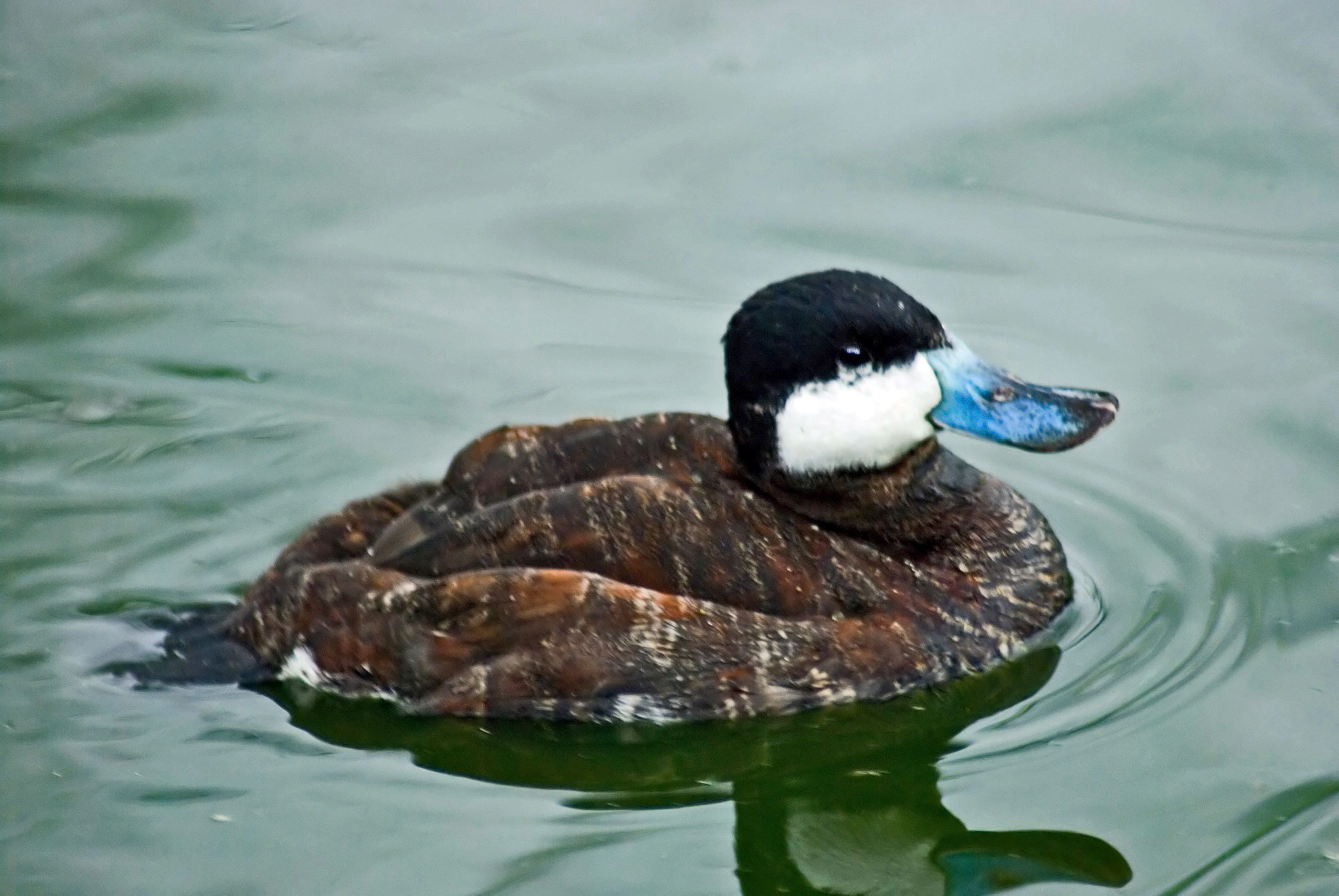
Ruddy duck numbers in the UK cut to 120 by cull

Photo: Wikipedia
1 March 2011

A cull of ruddy ducks in the UK has cut their numbers to just 120.

The government says about 4,400 of the birds were shot dead over the past five years.

Supporters of the cull, including the RSPB, say it is needed to protect other species from extinction. Opponents argue it is expensive and unnecessary.

The ruddy duck is originally from the United States, and came to the UK in the 1940s.

Experts say it has threatened the existence of the white-headed duck in Spain by interbreeding with it.
'Very effective'

Figures released by the Department for Environment, Food and Rural Affairs (Defra) show that 1,365 of the birds were killed in 2008, with the number falling to 717 in 2009, and 386 last year.

Duck shooters from the Food and Environment Research Agency killed the birds under licences issued by government officials.

Junior environment minister, Richard Benyon, said: "Defra considers the programme to date has been very effective. We remain committed to continuing the eradication programme through to completion."

The nationwide cull of ruddy ducks was ordered by the British government in 2003 after a request from Spanish authorities.

The bird was often found in the West Midlands, northern England, Anglesey and southern Scotland.

'Sad'

In 2007, bird lovers in Greater Manchester tried to get the cull stopped. They argued the white-headed duck population in Spain had recovered substantially.

Some critics argued the British cull was pointless unless other European countries also took action.

But the RSPB continues to back the actions of the UK government.

David Hoccom, head of the charity's species policy unit, said: "It is very sad that such measures are necessary, but we expect the white-headed duck's future to be more secure as a result."

"The white-headed duck has undergone a rapid worldwide decline over the last decade, making extinction a real possibility."

http://www.bbc.co.uk/news/uk-12603625
(Submitted by Dawn Holloway)

Tuesday, February 8, 2011

Endangered species: Cull to be kind?

When breeding programs are successful, endangered species are saved from extinction. But if too many animals are born, zoos have to take drastic steps

Three little pigs: the red river hogs that were
supposed to be at risk of being put down
By Gillian Orr
Tuesday, 8 February 2011

A debate was sparked last week when stories emerged that Edinburgh Zoo was planning to cull three of its red river hog piglets because they were "surplus to requirement". While the zoo has since stressed that it has no current plans to euthanise the animals and that the story was inaccurately reported, it did cull two other piglets last August.

While we are familiar with culling animals in the wild, the idea that this also goes on in zoos has proved much more controversial, it seeming at odds with the premise of breeding programmes. So why do zoos ever make the unusual decision of killing their animals?

The European Endangered Species Programme (EEP) is a type of population management for rarer species of animals that are found in zoos. One person is assigned a species and is in charge of producing a plan for the future management of it and co-ordinating its breeding through a process called "recommendation".

Recommendations are made each year on which animals should breed or not breed, and which individual animals should go from one zoo to another or on breeding loans. When faced with more animals, the EEP can recommend that the zoo cull the surplus, as happened last year.

A spokesperson for Edinburgh Zoo explains why animals are allowed to breed even if they don't want any more: "While the red river hog is not currently classed as endangered, it is conservation-dependent due to excessive hunting in its natural habitat in West Central Africa. The category status of any animal, however, always has the potential to worsen in the future. Therefore, all zoos are advised that their animals should remain able to breed, as restricting natural breeding activity or administering contraception can prove detrimental to health and future reproduction. Of course, this often leads to new introductions to the zoo population."

As money can be scarce, rehousing is not always an option. "As a registered charity, the Royal Zoological Society of Scotland has to remain mindful of the resources it has available," the zoo says. "When we are unable to accommodate new additions to our facilities, rehoming is always our top priority, but there are various restrictions involved that make it easier said than done. Animals within the EEP zoo structure must be rehomed within it, or similar bodies within the developed world, to maintain control over their location and welfare. Many facilities within the EEP structure share a similar range of species and, therefore, are not in a position to accommodate more of the same."

However, animal charities have questioned zoo culls and the reasoning behind them. Libby Anderson, a director at animal protection charity OneKind, has said: "Each animal is an individual and I don't think they can possibly justify killing hogs simply because they are deemed surplus to the requirements of a breeding programme."

Population management of animals remains a complex and sensitive subject, but, happily for the three piglets, they are safe for the time being.

http://www.independent.co.uk/environment/endangered-species-cull-to-be-kind-2207350.html

Wednesday, September 15, 2010

Badger cull plans for England being unveiled

15 September 2010

The government has set out plans to license farmers in England to shoot badgers on their land, with tens of thousands of animals potentially targeted.

The government believes the badger cull is necessary to curb tuberculosis in cattle.

Cattle TB cost the UK more than £100m last year.

But campaigners who successfully mounted a legal challenge against plans for a cull in Wales say the scientific evidence for culling does not stack up.

The European badger (Meles meles) is a protected species under European and British law, but ministers can sanction killing in certain circumstances, including to tackle diseases.

It is believed the government will change the instructions it gives to Natural England, the statutory agency that issues licences, in order that farmers can gain permission to kill badgers on the basis that they carry the bovine TB bacterium.

The previous Labour government concluded culling did not make scientific or economic sense, and instructed the agency not to issue licences for TB control.

Ministers in the Conservative-Lib Dem coalition, however, believe the latest scientific evidence changes the picture.

Agriculture Minister Jim Paice said before the election that the Conservatives favoured culling. Since coming into office he has several times pledged to make it happen, although his boss, Environment Secretary Caroline Spelman, has been more nuanced, promising only a strategy based on science.

Split vision

Whether science does back a cull or not is a hotly-disputed question.

Some of the scientists who performed the biggest ever investigation into culling - the UK's Randomised Badger Culling Trial (RBCT), also known as the "Krebs Trial" - maintain that it does not.

The Krebs Trial found that the incidence of TB fell in cattle herds inside the culling zone, but rose outside, probably because killing badgers disrupted the animals' social structures, making them range further and along less ordered trails in search of food and territory, bringing them into contact with more cattle.

The team concluded at that time that culling could not be an ingredient of an effective bovine TB control programme; and some of them, at least, say that is still the case.

However, other observers point out that in the four years since the Krebs trial concluded, the "perturbation effect" has fallen away while some benefit appears to persist inside the culled zone.

Two months ago, the Court of Appeal upheld an appeal by the Badger Trust against the Welsh Assembly Government's plans for a trial cull in Pembrokeshire.

One of the reasons for the judgement was that proponents expected the measure to produce only a 9% decline in TB in cattle, which the court ruled was not a "substantial reduction", as required by the Animal Health Act.

Defra is using different legislation, the Protection of Badgers Act. Even so, campaigners are expected to explore legal options if they do not think the law is being properly applied.

"The Badger Trust is monitoring things very closely and we hope [Defra] will take a considered view of the science that is overwhelmingly against culling," said Gwendolen Morgan of Bindmans solicitors, the organisation's legal advisor.

The government's consultation is expected to last for three months.

http://www.bbc.co.uk/news/science-environment-11303939
(Submitted by Dawn Holloway)

Badger cull plans for England being unveiled

15 September 2010

The government has set out plans to license farmers in England to shoot badgers on their land, with tens of thousands of animals potentially targeted.

The government believes the badger cull is necessary to curb tuberculosis in cattle.

Cattle TB cost the UK more than £100m last year.

But campaigners who successfully mounted a legal challenge against plans for a cull in Wales say the scientific evidence for culling does not stack up.

The European badger (Meles meles) is a protected species under European and British law, but ministers can sanction killing in certain circumstances, including to tackle diseases.

It is believed the government will change the instructions it gives to Natural England, the statutory agency that issues licences, in order that farmers can gain permission to kill badgers on the basis that they carry the bovine TB bacterium.

The previous Labour government concluded culling did not make scientific or economic sense, and instructed the agency not to issue licences for TB control.

Ministers in the Conservative-Lib Dem coalition, however, believe the latest scientific evidence changes the picture.

Agriculture Minister Jim Paice said before the election that the Conservatives favoured culling. Since coming into office he has several times pledged to make it happen, although his boss, Environment Secretary Caroline Spelman, has been more nuanced, promising only a strategy based on science.

Split vision

Whether science does back a cull or not is a hotly-disputed question.

Some of the scientists who performed the biggest ever investigation into culling - the UK's Randomised Badger Culling Trial (RBCT), also known as the "Krebs Trial" - maintain that it does not.

The Krebs Trial found that the incidence of TB fell in cattle herds inside the culling zone, but rose outside, probably because killing badgers disrupted the animals' social structures, making them range further and along less ordered trails in search of food and territory, bringing them into contact with more cattle.

The team concluded at that time that culling could not be an ingredient of an effective bovine TB control programme; and some of them, at least, say that is still the case.

However, other observers point out that in the four years since the Krebs trial concluded, the "perturbation effect" has fallen away while some benefit appears to persist inside the culled zone.

Two months ago, the Court of Appeal upheld an appeal by the Badger Trust against the Welsh Assembly Government's plans for a trial cull in Pembrokeshire.

One of the reasons for the judgement was that proponents expected the measure to produce only a 9% decline in TB in cattle, which the court ruled was not a "substantial reduction", as required by the Animal Health Act.

Defra is using different legislation, the Protection of Badgers Act. Even so, campaigners are expected to explore legal options if they do not think the law is being properly applied.

"The Badger Trust is monitoring things very closely and we hope [Defra] will take a considered view of the science that is overwhelmingly against culling," said Gwendolen Morgan of Bindmans solicitors, the organisation's legal advisor.

The government's consultation is expected to last for three months.

http://www.bbc.co.uk/news/science-environment-11303939
(Submitted by Dawn Holloway)

Wednesday, July 14, 2010

Badger cull in Wales quashed in the Court of Appeal

14.07.10

The badger cull in Wales which was given the go ahead in January by the Welsh Assembly Government has been quashed in the Court of Appeal.

Following the success of the appeal we have issued this statement:
We are delighted to hear that the Badger Trust's appeal has been allowed.

The RSPCA has always been firmly opposed to the proposed cull in Wales as we do not believe that the science justifies it. We believe that vaccination, increased levels of testing, improved biosecurity and stricter controls on the movement of cattle are more sustainable and effective ways of reducing the incidence of bovine tuberculosis (TB) in cattle.

We are, however, pleased with the concessions which were made. As we said in our response to the Welsh Assembly Government's original consultation (on Tuberculosis Eradication Order 2009), we always had concerns that the proposed legislation applied to the whole of Wales and should have been more specific.

This is a timely reminder about the importance of meticulous attention to detail before any culling regime is considered.
We realise that bovine TB is a serious issue but don't believe that a cull of badgers is an appropriate, practical or ethical solution. Many of the badgers culled would be likely to be disease-free.

Vaccination project

Last month we reported on our dismay at the coalition government cuts to a project to vaccinate badgers against bovine TB due to take place this summer.

The project regarding the use of an injectable badger tuberculosis vaccine was initially announced on Thursday, 19 March by the then Environment Secretary, Hilary Benn. He said that the first vaccine against bovine TB in badgers would be used in the field in England, in Staffordshire, Herefordshire/Worcestershire and Devon.

Find out more about the proposed cuts to the project in our previous news story: Dismay at cuts to badger vaccination policy.

Back off badgers!

Show your support against the possible badger cull in England.

Give Animals A Voice

http://www.rspca.org.uk/media/news/story/-/article/EM_Badger_Trust

Monday, March 29, 2010

Hope for Scotland's red squirrels

SEEING RED: Hope is on the horizon for Scotland's threatened red squirrels. A vaccine is being developed to protect them against a deadly disease carried by their grey cousins. The inoculation could prevent the species from being wiped out if a culling programme to kill the invading greys proves ineffective. The vaccine being worked on at the Moredun Research Institute in Midlothian could be ready in five years. Grey squirrels were introduced to Britain from the US more than 100 years ago.

http://e-edition.metroherald.ie/2010/03/29/
- p8.

Sunday, February 28, 2010

Zoologists call for culling of stray dogs to stop rabies

Thu., February 25, 2010
By Zafrir Rinat

Senior ecologists and zoologists warned this week of rabies spreading in Israel following refusal of the environmental protection minister to authorize a culling of stray dogs, which spread the disease.

The scientists urged Minister Gilad Erdan to revoke the decision he made at the beginning of the year and allow Israel Nature and Parks Authority inspectors to cull stray dogs.

The Agriculture Ministry said the rabies eruption in the past year was marked by a considerable increase in rabid dogs, both stray and pets.

Failure to cull stray dogs increases their numbers, which in turn raises the risk of spreading the disease, the scientists say. In addition, stray dogs mean increased attacks on wild animals and threatens the extinction of certain species, they said.

Until recently the Veterinary Services in the agriculture and environment ministries used to authorize INPA inspectors to cull stray dogs to prevent rabies from spreading. Erdan demanded the Agriculture Ministry issue regulations determining what circumstances justify shooting dogs before approving the culling.

"Stray dogs wandering in packs have significantly reduced gazelles' ability to reproduce," the scientists wrote to Erdan. "Packs of dogs have devoured rare roe deer in Ramat Hanadiv and four female Persian fallow deer, one of the rarest species in the world, which Israel is saving from extinction and returning to the wild," they wrote.

"I've received complaints from several regions about shooting dogs and of dogs left dying in the field," Erdan said, confirming that he has not authorized culling stray dogs. "It confuses many people who think INPA's job is to protect animals and don't understand why they're shooting dogs. I found there are no clear regulations saying where and in what circumstances shooting stray dogs is permitted," he said.

http://www.haaretz.com/hasen/spages/1151939.html

Thursday, November 26, 2009

Humpback Horror: Camel Chaos In Oz

RIGHT: Camels were used by white settlers who built roads and railways across the Outback

Thursday November 26, 2009
Ian Woods, Sky correspondent in Australia

Around 6,000 feral camels are rampaging through a remote Australian town causing chaos and terrifying the locals, prompting the government to organise a mass cull.

The Northern Territory government said that the community of Docker River was "under siege".

Local government minister Rob Knight said: "They've actually come right into the community smashing infrastructure, so it's become a critical situation.

"There are health issues, there are camels being trampled, and dead carcasses in the community.

"They are smashing over water mains and intruding on the airstrip, causing problems with medical evacuations."

Many of the 330 residents are said to be too scared to leave their homes. The town is around 150 miles west of Uluru, commonly known as Ayers Rock.

Graham Taylor, the chief executive of local authority Macdonnell Shire, told Sky News it was a crisis.

"It began four weeks ago with 25 or 30 camels, but every day more and more turned up looking for water," he said.

He said the camels would be rounded up and taken out of town to be shot humanely.

The animals are part of a wild herd of more than a million camels which roam the central Australian desert.

They were introduced to the country in the 19th century when white settlers built roads and rail across the Outback, and used the animals for transportation.

The camels were set free afterwards, and have been breeding ever since.

With few natural predators and vast sparsely-populated areas in which to roam, the camel population has soared, putting pressure on native species by reducing food sources, destroying habitat and spreading disease.

Earlier this year, the Federal government announced it was allocating £10m to tackle the problem.

See video at: http://news.sky.com/skynews/Home/World-News/Wild-Camels-On-The-Rampage-In-Australia-Animals-To-Be-Culled-In-Northern-Territory/Article/200911415469393?f=rss

Humpback Horror: Camel Chaos In Oz

RIGHT: Camels were used by white settlers who built roads and railways across the Outback

Thursday November 26, 2009
Ian Woods, Sky correspondent in Australia

Around 6,000 feral camels are rampaging through a remote Australian town causing chaos and terrifying the locals, prompting the government to organise a mass cull.

The Northern Territory government said that the community of Docker River was "under siege".

Local government minister Rob Knight said: "They've actually come right into the community smashing infrastructure, so it's become a critical situation.

"There are health issues, there are camels being trampled, and dead carcasses in the community.

"They are smashing over water mains and intruding on the airstrip, causing problems with medical evacuations."

Many of the 330 residents are said to be too scared to leave their homes. The town is around 150 miles west of Uluru, commonly known as Ayers Rock.

Graham Taylor, the chief executive of local authority Macdonnell Shire, told Sky News it was a crisis.

"It began four weeks ago with 25 or 30 camels, but every day more and more turned up looking for water," he said.

He said the camels would be rounded up and taken out of town to be shot humanely.

The animals are part of a wild herd of more than a million camels which roam the central Australian desert.

They were introduced to the country in the 19th century when white settlers built roads and rail across the Outback, and used the animals for transportation.

The camels were set free afterwards, and have been breeding ever since.

With few natural predators and vast sparsely-populated areas in which to roam, the camel population has soared, putting pressure on native species by reducing food sources, destroying habitat and spreading disease.

Earlier this year, the Federal government announced it was allocating £10m to tackle the problem.

See video at: http://news.sky.com/skynews/Home/World-News/Wild-Camels-On-The-Rampage-In-Australia-Animals-To-Be-Culled-In-Northern-Territory/Article/200911415469393?f=rss

Monday, June 22, 2009

OFF THE PIGS


More than 500 wild hogs removed from Smokies
Posted 6/20/2009 4:20 PM ET
GATLINBURG, Tenn. (AP) — Wildlife managers at the Great Smoky Mountains National Park have removed more than 500 wild hogs this year -- the most removed since 1987.

Since the late 1950s, the park has removed almost 12,000 wild hogs. The animals are a target for control because they're nonnative and do considerable damage to the ecosystem by eating rare plants and salamander, defecating in streams and churning up the ground.

In a typical year, park hog hunters trap and shoot about 275 hogs from the park, most of them from the North Carolina side. Biologists attribute the recent increase to several years of bountiful mast crops, especially acorns.

None of the wild pigs is trapped and relocated outside the park because of concerns over the animals transmitting diseases like pseudorabies and swine brucellosis.

The park's hog population traces back to the early 1920s, when a herd of European wild hogs escaped from a game reserve in Graham County, N.C. By the 1940s, the wild hogs had spread into other counties as well as the Smokies. Kim DeLozier, chief wildlife biologist for the Smokies, said he believes the pig population has also been bolstered by domestic pigs that have escaped or been released into the wild.

"Our pigs may be increasing because of people illegally releasing feral pigs around the park boundary," DeLozier said. "We know that, because our pigs have taken on a different appearance than the pure European species." The wild hogs have lean hips, large tusks, straight tails and split guard hairs.

"These are marathon pigs," DeLozier said. "They're lean and mean, not fat and sassy." The feral pigs often have spots and curly tails. DeLozier said feral pigs tend to travel in larger groups than the traditional European strain and are easier to trap and control.

As the park's original wild hogs breed with feral pigs, the outcome will be animals that are somewhat closer to feral pigs in appearance and behavior, DeLozier said.

"The traditional pigs we've dealt with for the past 25 years tend to be more solitary and much tougher to bait," he said. "Normally, they don't run in big groups. In the past several years, we're seeing two or three sows together with large groups of piglets."

Sunday, June 7, 2009

Feral dogs may be culled to protect wildlife in Sikkim forests

Sunday, June 7, 2009

GANGTOK: Dogs, which once lived near army and paramilitary camps in Sikkim and survived on leftovers, have turned feral, killing and devouring wild animals, forcing authorities to consider the option of culling them.

A number of wild animals like Red Panda, Musk Deer, Ghorals and even migratory birds have been killed and devoured by the dogs in the past couple of months, Forest officials said. In the latest instance, a pack of dogs and jackals entered an enclosure at the Himalayan Zoological Park at Bulbuley in East Sikkim on May 31 and killed and ate an adult Red Panda.

The Chief Wildlife Warden NT Bhutia said that a report has been sought from the zoo authorities. Describing the reports of attacks by dogs on the wild animals as a serious matter, he said that if needed they may have to be culled to protect wildlife in forests.

Among measures for strengthening the security of the zoo and wildlife sanctuaries from the dogs, Bhutia said additional funds have been give to the zoo authorities to strengthen fencing. - PTI

http://www.thehindubusinessline.com/blnus/27071720.htm

Thursday, June 4, 2009

Prince Charles calls for squirrel cull

Prince Charles is urging landowners to eradicate grey squirrels to save trees from being destroyed.

"The greys are doing immense and increasing damage to hardwoods all over the country and threaten to compromise all our efforts to restore native woodlands," the prince wrote in a letter to the Country Land and Business Association (CLA).

Grey squirrels damage broadleaved trees by nibbling the inner bark, making it hard for owners of forests and woodland to grow the hardwoods required for financial viability, the CLA wrote in a study.

The prince added that wiping them out would also be the only way of saving the native red squirrels, which are smaller and weaker than their grey counterparts.

Unlike the greys, red squirrels can die from a virus carried by both species of squirrel, and the squirrel parapoxvirus is believed to have killed up to 80 percent of the red squirrel population in certain parts of the country in 2008.

"The prince is a big land owner and tree-lover," CLA spokesman Oliver Wilson said on Thursday, "that's why he has such a strong interest in this issue."

Grey squirrels are not native to Britain but have spread rapidly across the country since being introduced from the United States and Canada around the start of the 20th century.

In the past, politicians and environmentalists have discussed measures to limit the boom of the grey squirrel, which has few natural predators and is classed as a pest. One politician has even suggested celebrity chef Jamie Oliver encourage schoolchildren to eat them.

Under a law passed in 1981, it is illegal to release a grey squirrel into the wild after it has been trapped. Instead it should be humanely destroyed.

(Reporting by Josie Cox, editing by Paul Casciato)

http://uk.news.yahoo.com/22/20090604/tuk-uk-britain-squirrels-fa6b408_2.html

Sunday, March 29, 2009

'War' on poisonous Australia toad


People in the Australian state of Queensland have taken part in a mass-killing of poisonous cane toads, as part of a collective effort at pest control, known as Toad Day Out.

The toads have to be captured unharmed, examined by experts, and then killed humanely under the event rules.

http://news.bbc.co.uk/1/hi/world/asia-pacific/7970877.stm