Showing posts with label Phillipines. Show all posts

Friday, July 1, 2011

Seven new species of mice discovered in The Philippines

http://www.wildlifeextra.com/go/news/philippines-mouse.html#cr

June 2011. A group of American and Filipino biologists have discovered seven previously unknown species of mammals in the Philippines, increasing the number of native mammals known from Luzon Island (excluding bats) from 42 to 49, some 17 percent!

"These animals are part of the rich biological heritage of the Philippines", said Dr. Theresa Mundita Lim, Director of the Protected Areas and Wildlife Bureau, Department of the Environment and Natural Resources (DENR). "The forests where they live are crucial watershed areas for Manila and many other cities. Protecting their mountain forest habitat is good for them and for people." The DENR is a collaborator of the project, providing assistance at field sites and co-organizing conferences on wildlife and conservation.

Read on...

Thursday, June 30, 2011

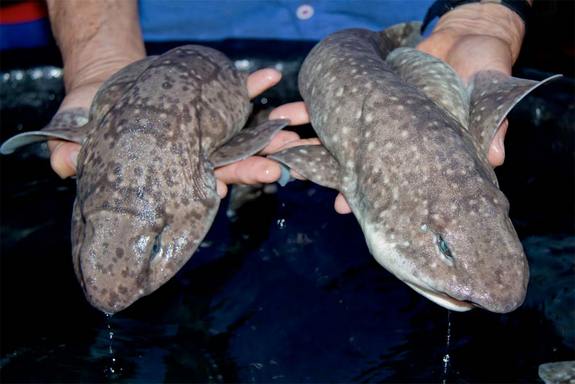
Inflatable Shark Among 300 New Species Discovered in Philippines

http://beta.news.yahoo.com/inflatable-shark-among-300-species-discovered-philippines-135007930.html


A treasure trove of hundreds of new species may have been discovered in the Philippines, including a bizarre sea star that feeds exclusively on sunken driftwood and a deep-sea, shrimp-eating shark that swells up to scare off other predators. Scientists braved leeches and a host of venomous creatures from the mountains to the sea to uncover more than 300 species that are likely new to science. These findings include dozens of new insects and spiders, more than 50 colorful new sea slugs and a number of deep-sea armored corals "which protect themselves against predatory nibbles from fish by growing large, spiky plates," said researcher Terrence Gosliner, dean of science and research collections at the California Academy of Sciences and leader of the 2011 Philippine Biodiversity Expedition.


Read on...

Friday, June 24, 2011

Illegal Wildlife Traders Target Endemic Geckos (Via Herp Digest)

Illegal Wildlife Traders Target Endemic Geckos
By Carla P. Gomez, Inquirer Visayas, 6/1/11

BACOLOD CITY, Philippines-The tuko has been making a lot of noise in the wildlife trade-and conservationists don't like what they're hearing.

Environment officials here are looking into reports that foreigners have been offering hefty sums to buy native geckos, locally known as tuko, a nocturnal lizard one would either love or hate for the loud sound it makes.

Some buyers are reportedly willing to pay P100,000 or more each for geckos that weigh at least 500 grams, according to Valentin Talavero, head of the Provincial Environment and Natural Resources Office.

Among the purported buyers are Korean and Chinese nationals, the latter said to be interested in geckos for their AIDS research, Talavero told the Inquirer on Monday.
Errol Abada Gatumbato, vice president and managing director of the Philippines Biodiversity Conservation Foundation Inc., said gecko "collection" seemed to have gone unchecked not only in Negros, but in other provinces where the species still thrive.

Reports reaching his group indicated that the sought-after lizards were being used either for gaming or medicinal purposes, Gatumbato added.

"This is quite alarming because there are endemic geckos with conservation values," he added, citing sketchy accounts of "clandestine buying" all over the country.

In interviews with the Inquirer, several Negrenses who asked not to be identified admitted to poaching the native gecko population for sale to foreign buyers.

A more enterprising resident said he even "fattened" the lizards first in captivity.
But whether in rural or urban areas, one need not look far to have a sense of the growing tuko trafficking.

For example, information on which types of geckos are in demand-and how to sell them-is easily available on www.tuko.com.ph.

The website even lists down the characteristics of a "perfect tuko." To supposedly fetch a higher price, a gecko should sport red, orange or white spots on its skin, their feet splayed flat and shaped like a flower.

A marketable gecko should also weigh 400 grams or more, with a body length of at least 21 inches, the website said. It should look healthy-no severed body parts-and fed with food (mainly insects) found in their natural environment.

The gecko must also be active and fierce when one tries to hold it, the website added.

Geckos are also sold at sulit.com.ph, a popular buy-and-sell site.

And yet on paper, the prized lizards supposedly enjoy the full protection of the law.
Under the Wildlife Act of the Philippines, the collection of wildlife species such as the tuko requires a permit from the Protected Areas and Wildlife Bureau (PAWB), Gatumbato said.
'
Reached for comment in Manila, PAWB Director Theresa Mundita Lim maintained that poaching and selling geckos are "illegal activities."

But lacking ample data on the country's gecko population, the government could not ascertain at the moment whether the species should be considered endangered or not, Lim said.
"We need to ensure first that its natural population will not be affected. Without that, it's illegal to catch it," the PAWB chief stressed.

According to Lim, geckos largely figure in the wildlife trade because of a demand in China, where their body parts are used in Chinese medicine.

Joan Gerangaya, head of the City Environment and Natural Resource Office, said several locals had asked his office to issue permits to "transport" tuko, but that they were all turned down since it would be in violation of the wildlife act.

Those interested in "breeding" tuko, however, may secure special permits from regional offices of the Department of Environment and Natural Resources, Gerangaya added. With a report from Kristine L. Alave in Manila

Wednesday, February 2, 2011

Philippine Croc May Be Extinct in 10 Years (Via Herp Digest)

Philippine Croc May Be Extinct in 10 Years
By Charlie Lagasca (The Philippine Star) Updated January 27, 2011 12:00 AM
Only 100 mature Philippine crocodiles are left in the wilds of Isabela and Liguasan Marsh in Maguindanao.

BAYOMBONG, Nueva Vizcaya, Philippines - The Philippine crocodile, classified as critically endangered by the World Conservation Union, will be extinct in 10 years if no conservation measures are immediately undertaken.

The Mabuwaya Foundation Inc. (MFI), an organization engaged in protecting the species, said only 100 mature Philippine crocodiles are left in the wilds of Isabela and Liguasan Marsh in Maguindanao.

Philippine crocodiles (scientific name Crocodylus mindorensis) are endemic to the country. They thrive in freshwater and are non-threatening to humans unless provoked.

"The Philippine crocodile is the world's most severely threatened crocodile species. It is at a real risk of going extinct in the near future if no conservation action is taken," said Marites Balbas, communication officer of Mabuwaya Foundation.

The foundation collaborates with international conservationist group Critical Ecosystem Partnership Fund and the Department of Environment and Natural Resources.

The foundation will release today 19 baby Philippine crocodiles in the wetlands of San Mariano in Isabela where 49 young crocodiles of same species had been released two years ago.

These were caught in hatchling stage and raised in captivity for a year and a half until it was determined that they could survive in the wild.

The procedure, called "head-starting," has been practiced since 2005 to raise the Philippine crocodile population by increasing the survival chances of newborn crocodiles in the wild.

The crocodiles will be released in honor of the inauguration of the foundation's Municipal Philippine Crocodile Rearing Station in San Mariano.

The population of Philippine crocodiles is threatened by hunting and the conversion of their natural habitat -creeks, ponds, and marshes - into residential or commercial spaces.

Another crocodile species endemic to the Philippines is the saltwater crocodile (Crocoydlus porosus). It is, however, not endangered like the Philippine crocodile.

The law prohibits hunting, killing, selling, and buying of the species. Violators will be fined P100,000.

Sunday, November 21, 2010

‘Native trees will bring back birds’

Indigenous trees can restore the biodiversity of birds in Cebu’s forests, a birdwatcher said.


“There are birds that feed on specific food and insects from trees that are gone,” Nilo Arribas, a birdwatcher and photographer, told CEBU DAILY NEWS.

Arribas and 13 individuals and institutions signed yesterday a memorandum of agreement with the Ramon Aboitiz Foundation Inc. (RAFI) for a project dubbed Generation Redemption and Expansion of Natural resources Initiatives (GREENIN) in the Philippines, which aims to restore biodiversity in the country’s forests.

“We are planting native trees to fit the birds,” Roberto Aboitiz, RAFI president, said.

Ruth Alensonorin, executive director of RAFI’s integrated development program, said that they aim to plant at least 1,670 trees per hectare of land.

The stakeholders would also be oriented on activities such as weeding, watering, applying fertilizer to the seedlings and monitoring the tree plantations.

Arribas said Cebu's continuing urban growth, with forests cleared to make room for infrastructure, is destroying the natural habitat of birds.

The rare Cebu flowerpecker, which was often sighted 30 years ago, is now almost extinct, Arriba said.

The canary flycatcher is still found in Consolacion town, north Cebu, but their population is also declining, he said.

Reforestation efforts using trees that are not native to the area will change forest biodiversity.

Arriba cited the man-made forest in Bohol that has many exotic trees but less biodiversity.

“We need not just a thick forest, but also a living forest,” he said.

By Candeze R. Mongaya

Cebu Daily News

http://globalnation.inquirer.net/cebudailynews/news/view/20101120-304266/Native-trees-will-bring-back-birds