These things happen: a dead six-to-eight-foot shark was found somehwhere in the middle of the forest in Milton, New Hampshire, about an hour away from the closest salt water.
KSDK
video: http://www.blameitonthevoices.com/2011/08/shark-in-woods.html
Showing posts with label shark. Show all posts
Showing posts with label shark. Show all posts
Friday, August 12, 2011

Thursday, June 30, 2011
Inflatable Shark Among 300 New Species Discovered in Philippines
http://beta.news.yahoo.com/inflatable-shark-among-300-species-discovered-philippines-135007930.html
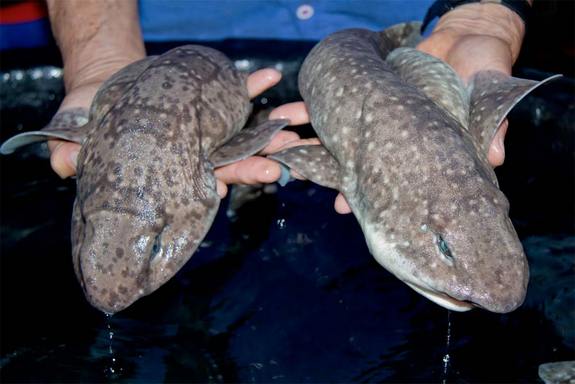
A treasure trove of hundreds of new species may have been discovered in the Philippines, including a bizarre sea star that feeds exclusively on sunken driftwood and a deep-sea, shrimp-eating shark that swells up to scare off other predators. Scientists braved leeches and a host of venomous creatures from the mountains to the sea to uncover more than 300 species that are likely new to science. These findings include dozens of new insects and spiders, more than 50 colorful new sea slugs and a number of deep-sea armored corals "which protect themselves against predatory nibbles from fish by growing large, spiky plates," said researcher Terrence Gosliner, dean of science and research collections at the California Academy of Sciences and leader of the 2011 Philippine Biodiversity Expedition.
Tuesday, June 28, 2011
Shark jumps over surfer
An amazing video of a shark jumping over a surfer in Florida has become an online hit.
The video was shot by photographer Jacob Langston who inadvertently captured the action while filming surfers off New Smyrna Beach.
Mr Langston, who works for the Orlando Sentinel, said: "I didn't even see the shark jump. But a surfer came up to me and said, "Hey man, did you see that?""
Read on...
The video was shot by photographer Jacob Langston who inadvertently captured the action while filming surfers off New Smyrna Beach.
Mr Langston, who works for the Orlando Sentinel, said: "I didn't even see the shark jump. But a surfer came up to me and said, "Hey man, did you see that?""
Read on...

Tuesday, June 14, 2011
St Ives harbourmaster told of two 'shark sightings'
 |
| The oceanic whitetip shark is usually found nearer Portugal |
Sightings of a species of shark known to attack humans have been reported to harbour officials in Cornwall.
The harbourmaster's office in St Ives said two people on separate boats had reported seeing an oceanic whitetip shark about a mile (1.6km) offshore.
But a spokesman for the office said it was not "100% sure" yet if the creatures spotted by the fishermen were oceanic whitetips.
He said people should not "blow the reports out of all proportion".
'All is calm'
The oceanic whitetip shark is usually found far further south in deeper waters away from the coast, with Portugal being the usual northern-most reach of its habitat.
The Shark Trust said that the chances of the species being in British waters were very small and it would want to see photos or video footage before confirming a sighting.
Although the species had been known to attack humans, trust president Richard Pierce, from Bude, said there was only believed to have been one oceanic whitetip-related death within the past year in the world.
He said: "If I was swimmer in Cornwall I would not be worried."
Despite being cautious about the sighting, Mr Pierce added that it was "always exciting and interesting to get sighting reports of what may be new species to our waters".
The Mayor of St Ives Ron Tulley said that "panic hasn't struck and all is peaceful and very calm in St Ives", despite the reports.
"We've had lots of people on holiday and people relaxing on the beach with not much fear of a shark attack," he said.
Feed on plankton
"These stories do surface at intervals. If a fisherman said he saw it, then it is possible, but it does seem unlikely.
"It could have been some other creature."
Basking sharks are regular visitors to the county's shores, appearing each summer to feed on plankton.
Other species have been found washed up on the county's beaches, including a 12ft (3.8m) thresher shark, which was found in Hayle in 2009.
http://www.bbc.co.uk/news/uk-england-cornwall-13759504
Man eating shark spotted off St Ives coast
12:40pm Monday 13th June 2011
Fishermen have reporting sightings of one of the world's most aggressive sharks off the Cornish coast.
Three witnesses said they saw an oceanic whitetip in St Ives Bay.
The species is responsible for more human deaths than all other shark species combined.
The sightings were reported to the harbourmaster at St Ives.
The whitetip normally lives in warmer waters, but rising temperatures have seen several new species found in Cornish waters.
http://www.falmouthpacket.co.uk/news/camborneandredruth/9080445.Man_eating_shark_spotted_off_St_Ives_coast/?ref=mr
(Submitted by Liz R)
Fishermen have reporting sightings of one of the world's most aggressive sharks off the Cornish coast.
Three witnesses said they saw an oceanic whitetip in St Ives Bay.
The species is responsible for more human deaths than all other shark species combined.
The sightings were reported to the harbourmaster at St Ives.
The whitetip normally lives in warmer waters, but rising temperatures have seen several new species found in Cornish waters.
http://www.falmouthpacket.co.uk/news/camborneandredruth/9080445.Man_eating_shark_spotted_off_St_Ives_coast/?ref=mr
(Submitted by Liz R)
Feared 'Deadly Shark' Spotted Off Cornwall
Sky News – Mon, Jun 13, 2011
A species of shark thought to be to blame for hundreds of attacks on humans has been reported off the coast of Cornwall.
One sighting of an oceanic whitetip shark was made by a fisherman who said his wooden boat was rammed as he fished for mackerel.
The harbour master's office in St Ives confirmed that a second person on a separate boat had also reported seeing one of the sharks a mile off shore.
The species is blamed for many attacks on humans and brought terror to the Red Sea resort of Sharm el Sheikh last year when a 'rogue' whitetip reportedly killed a German woman .
A spokesman for the harbour master in St Ives said they were not "100%" sure if the sharks spotted were oceanic whitetips and stressed that people should not blow the reports "out of all proportion".
The pelagic - or ocean-going - species is usually found far further south in deeper waters away from the coast, with Portugal being the usual northern-most reach of its habitat.
http://uk.news.yahoo.com/feared-deadly-shark-spotted-off-cornwall-110415724.html
A species of shark thought to be to blame for hundreds of attacks on humans has been reported off the coast of Cornwall.
One sighting of an oceanic whitetip shark was made by a fisherman who said his wooden boat was rammed as he fished for mackerel.
The harbour master's office in St Ives confirmed that a second person on a separate boat had also reported seeing one of the sharks a mile off shore.
The species is blamed for many attacks on humans and brought terror to the Red Sea resort of Sharm el Sheikh last year when a 'rogue' whitetip reportedly killed a German woman .
A spokesman for the harbour master in St Ives said they were not "100%" sure if the sharks spotted were oceanic whitetips and stressed that people should not blow the reports "out of all proportion".
The pelagic - or ocean-going - species is usually found far further south in deeper waters away from the coast, with Portugal being the usual northern-most reach of its habitat.
http://uk.news.yahoo.com/feared-deadly-shark-spotted-off-cornwall-110415724.html
Saturday, February 12, 2011
Shark-Catching Nations Fail To Protect Threatened Species
NICOLE WINFIELD
01/27/11 03:10 PM
ROME — Two environmental groups on Thursday accused the 20 countries that catch the most sharks of failing to fulfill promises made to the U.N. to better conserve the animals that are increasingly threatened with extinction.
In 1999, more than 100 governments adopted a plan of action at the U.N. Food and Agriculture Organization to try to stem overfishing of sharks, pledging, among other things, to develop national action plans to ensure that shark catches are sustainable.
The non-governmental groups Traffic and the Pew Environment Group said Thursday that only 13 of the top 20 shark catching countries had developed national plans, and that it was unclear if such plans had done any good where they were adopted.
They issued their report ahead of a meeting next week of government members of the FAO's fisheries committee, which will discuss the state of the world's fisheries in detail.
Some 73 million sharks are killed annually, primarily to meet the high demand in Asia for fins which are used in shark fin soup.
Because sharks are slow growing, late to mature and produce few young, they are unable to replenish their populations as quickly when they are caught. As a result, some 30 percent of all shark species are now threatened or nearly threatened with extinction.
Traffic and Pew analyzed fisheries data and made a list of the top 20 shark catchers which account for nearly 80 percent of the total shark catch reported globally. In order, the top 10 are Indonesia, India, Spain, Taiwan, Argentina, Mexico, Pakistan, United States, Japan, and Malaysia. Yet according to the two groups, Indonesia has only made a draft national plan and India is developing one. Other countries have adopted them but, because reporting is voluntary, it's not clear if they've been implemented or have done any good.
The groups urged governments at the FAO meeting next week to have the U.N. agency complete a thorough review to determine what countries have and haven't done to comply with their pledges to manage their fisheries.
"The fate of the world's sharks is in the hands of the top 20 shark catchers, most of whom have failed to demonstrate what, if anything, they are doing to save these imperiled species," said Glenn Sant, Traffic's global marine program leader.
Jill Hepp, manager of shark conservation for Pew, said sharks play a critical role in the ocean environment.
"Where shark populations are healthy, marine life thrives; but where they have been overfished, ecosystems fall out of balance," she said.
The report suggests that national action plans with lofty goals that are never implemented might not be the answer to saving sharks. Rather, countries that take smaller, incremental steps toward conservation might achieve better results.
It noted that Palau had announced in 2009 it would create the world's first shark sanctuary by banning all commercial shark fishing in its territorial waters and that Honduras had announced a moratorium on shark fishing last year.
http://www.huffingtonpost.com/2011/01/30/sharkcatching-nations-fai_n_815064.html
01/27/11 03:10 PM
ROME — Two environmental groups on Thursday accused the 20 countries that catch the most sharks of failing to fulfill promises made to the U.N. to better conserve the animals that are increasingly threatened with extinction.
In 1999, more than 100 governments adopted a plan of action at the U.N. Food and Agriculture Organization to try to stem overfishing of sharks, pledging, among other things, to develop national action plans to ensure that shark catches are sustainable.
The non-governmental groups Traffic and the Pew Environment Group said Thursday that only 13 of the top 20 shark catching countries had developed national plans, and that it was unclear if such plans had done any good where they were adopted.
They issued their report ahead of a meeting next week of government members of the FAO's fisheries committee, which will discuss the state of the world's fisheries in detail.
Some 73 million sharks are killed annually, primarily to meet the high demand in Asia for fins which are used in shark fin soup.
Because sharks are slow growing, late to mature and produce few young, they are unable to replenish their populations as quickly when they are caught. As a result, some 30 percent of all shark species are now threatened or nearly threatened with extinction.
Traffic and Pew analyzed fisheries data and made a list of the top 20 shark catchers which account for nearly 80 percent of the total shark catch reported globally. In order, the top 10 are Indonesia, India, Spain, Taiwan, Argentina, Mexico, Pakistan, United States, Japan, and Malaysia. Yet according to the two groups, Indonesia has only made a draft national plan and India is developing one. Other countries have adopted them but, because reporting is voluntary, it's not clear if they've been implemented or have done any good.
The groups urged governments at the FAO meeting next week to have the U.N. agency complete a thorough review to determine what countries have and haven't done to comply with their pledges to manage their fisheries.
"The fate of the world's sharks is in the hands of the top 20 shark catchers, most of whom have failed to demonstrate what, if anything, they are doing to save these imperiled species," said Glenn Sant, Traffic's global marine program leader.
Jill Hepp, manager of shark conservation for Pew, said sharks play a critical role in the ocean environment.
"Where shark populations are healthy, marine life thrives; but where they have been overfished, ecosystems fall out of balance," she said.
The report suggests that national action plans with lofty goals that are never implemented might not be the answer to saving sharks. Rather, countries that take smaller, incremental steps toward conservation might achieve better results.
It noted that Palau had announced in 2009 it would create the world's first shark sanctuary by banning all commercial shark fishing in its territorial waters and that Honduras had announced a moratorium on shark fishing last year.
http://www.huffingtonpost.com/2011/01/30/sharkcatching-nations-fai_n_815064.html
Friday, February 11, 2011
Great White Shark Sighting Reported Off La Jolla Coast
Warnings Issued For Swimmers, Surfers, Divers In Area
POSTED: 3:46 pm PST February 10, 2011
SAN DIEGO -- A reported sighting of a small great white shark about 500 yards off the coast of La Jolla Cove Thursday prompted lifeguards to issue precautionary warnings to swimmers, surfers and divers entering the ocean in the area.
Two scuba divers said they saw the marine predator -- a roughly 5-foot-long specimen -- under roughly 30 feet of water about 1:30 p.m., lifeguard Lt. John Everhart said.
Due to the depth and distance from land at which the pair of women spotted the shark, lifeguards did not consider the animal's possible lingering presence in the area an imminent public threat, according to Everhart.
Still, lifeguards warned all entering the water in the area through the afternoon about the reported sighting as a precaution, he said.
http://www.10news.com/news/26825764/detail.html
POSTED: 3:46 pm PST February 10, 2011
SAN DIEGO -- A reported sighting of a small great white shark about 500 yards off the coast of La Jolla Cove Thursday prompted lifeguards to issue precautionary warnings to swimmers, surfers and divers entering the ocean in the area.
Two scuba divers said they saw the marine predator -- a roughly 5-foot-long specimen -- under roughly 30 feet of water about 1:30 p.m., lifeguard Lt. John Everhart said.
Due to the depth and distance from land at which the pair of women spotted the shark, lifeguards did not consider the animal's possible lingering presence in the area an imminent public threat, according to Everhart.
Still, lifeguards warned all entering the water in the area through the afternoon about the reported sighting as a precaution, he said.
http://www.10news.com/news/26825764/detail.html
Friday, October 1, 2010
Sailor's body found inside shark at Jaws Beach
The body of a sailor who disappeared off Jaws Beach – on an island where one of the "Jaws" movies was filmed – has been found inside the stomach of a shark.
Published: 11:20PM BST 15 Sep 2010
Police in the Bahamas used fingerprints to identify Judson Newton, although they are still waiting for DNA test results.
It is unclear if the 43-year-old Mr Newton was alive when he was eaten.
Mr Newton went on a boating trip with friends off Jaws Beach, where Jaws: The Revenge was filmed, on August 29.
The group, who were fishing off New Providence Island, encountered engine trouble and called for help.
Rescuers found three men aboard who said that Mr Newton and a friend jumped into the water to try to swim back to shore. Officials launched a search for them, but neither was found.
On September 4, a local investment banker caught the 12-foot tiger shark while on a deep-sea fishing trip and he said a left leg popped out of its mouth as they hauled it in.
When officers cut the shark open, they found the right leg, two severed arms and a severed torso.
One of Newton's friends, Samuel Woodside, 37, said that he was surprised when he heard police say Mr Newton probably drowned.
"To me, he was always a strong swimmer," Mr Woodside said. "I don't know what happened."
Mr Woodside said he and Mr Newton were childhood friends and would go fishing almost every weekend when Mr Newton wasn't working as a sailor on cargo boats or as a chef at local restaurants.
"He was a sailor, you see," he said. "Anywhere where he could get a fishing line, he would go there."
The beach near where Mr Newton was last seen is located on the small island where the 1987 Jaws film was partially filmed.
http://www.telegraph.co.uk/news/worldnews/centralamericaandthecaribbean/bahamas/8005531/Sailors-body-found-inside-shark-at-Jaws-Beach.html
Published: 11:20PM BST 15 Sep 2010
Police in the Bahamas used fingerprints to identify Judson Newton, although they are still waiting for DNA test results.
It is unclear if the 43-year-old Mr Newton was alive when he was eaten.
Mr Newton went on a boating trip with friends off Jaws Beach, where Jaws: The Revenge was filmed, on August 29.
The group, who were fishing off New Providence Island, encountered engine trouble and called for help.
Rescuers found three men aboard who said that Mr Newton and a friend jumped into the water to try to swim back to shore. Officials launched a search for them, but neither was found.
On September 4, a local investment banker caught the 12-foot tiger shark while on a deep-sea fishing trip and he said a left leg popped out of its mouth as they hauled it in.
When officers cut the shark open, they found the right leg, two severed arms and a severed torso.
One of Newton's friends, Samuel Woodside, 37, said that he was surprised when he heard police say Mr Newton probably drowned.
"To me, he was always a strong swimmer," Mr Woodside said. "I don't know what happened."
Mr Woodside said he and Mr Newton were childhood friends and would go fishing almost every weekend when Mr Newton wasn't working as a sailor on cargo boats or as a chef at local restaurants.
"He was a sailor, you see," he said. "Anywhere where he could get a fishing line, he would go there."
The beach near where Mr Newton was last seen is located on the small island where the 1987 Jaws film was partially filmed.
http://www.telegraph.co.uk/news/worldnews/centralamericaandthecaribbean/bahamas/8005531/Sailors-body-found-inside-shark-at-Jaws-Beach.html
Sailor's body found inside shark at Jaws Beach
The body of a sailor who disappeared off Jaws Beach – on an island where one of the "Jaws" movies was filmed – has been found inside the stomach of a shark.
Published: 11:20PM BST 15 Sep 2010
Police in the Bahamas used fingerprints to identify Judson Newton, although they are still waiting for DNA test results.
It is unclear if the 43-year-old Mr Newton was alive when he was eaten.
Mr Newton went on a boating trip with friends off Jaws Beach, where Jaws: The Revenge was filmed, on August 29.
The group, who were fishing off New Providence Island, encountered engine trouble and called for help.
Rescuers found three men aboard who said that Mr Newton and a friend jumped into the water to try to swim back to shore. Officials launched a search for them, but neither was found.
On September 4, a local investment banker caught the 12-foot tiger shark while on a deep-sea fishing trip and he said a left leg popped out of its mouth as they hauled it in.
When officers cut the shark open, they found the right leg, two severed arms and a severed torso.
One of Newton's friends, Samuel Woodside, 37, said that he was surprised when he heard police say Mr Newton probably drowned.
"To me, he was always a strong swimmer," Mr Woodside said. "I don't know what happened."
Mr Woodside said he and Mr Newton were childhood friends and would go fishing almost every weekend when Mr Newton wasn't working as a sailor on cargo boats or as a chef at local restaurants.
"He was a sailor, you see," he said. "Anywhere where he could get a fishing line, he would go there."
The beach near where Mr Newton was last seen is located on the small island where the 1987 Jaws film was partially filmed.
http://www.telegraph.co.uk/news/worldnews/centralamericaandthecaribbean/bahamas/8005531/Sailors-body-found-inside-shark-at-Jaws-Beach.html
Published: 11:20PM BST 15 Sep 2010
Police in the Bahamas used fingerprints to identify Judson Newton, although they are still waiting for DNA test results.
It is unclear if the 43-year-old Mr Newton was alive when he was eaten.
Mr Newton went on a boating trip with friends off Jaws Beach, where Jaws: The Revenge was filmed, on August 29.
The group, who were fishing off New Providence Island, encountered engine trouble and called for help.
Rescuers found three men aboard who said that Mr Newton and a friend jumped into the water to try to swim back to shore. Officials launched a search for them, but neither was found.
On September 4, a local investment banker caught the 12-foot tiger shark while on a deep-sea fishing trip and he said a left leg popped out of its mouth as they hauled it in.
When officers cut the shark open, they found the right leg, two severed arms and a severed torso.
One of Newton's friends, Samuel Woodside, 37, said that he was surprised when he heard police say Mr Newton probably drowned.
"To me, he was always a strong swimmer," Mr Woodside said. "I don't know what happened."
Mr Woodside said he and Mr Newton were childhood friends and would go fishing almost every weekend when Mr Newton wasn't working as a sailor on cargo boats or as a chef at local restaurants.
"He was a sailor, you see," he said. "Anywhere where he could get a fishing line, he would go there."
The beach near where Mr Newton was last seen is located on the small island where the 1987 Jaws film was partially filmed.
http://www.telegraph.co.uk/news/worldnews/centralamericaandthecaribbean/bahamas/8005531/Sailors-body-found-inside-shark-at-Jaws-Beach.html
Saturday, September 25, 2010
John Wilson lands monster 184lb blue shark in UK waters
25th September 2010
By Richard Lee
ANGLING legend John Wilson has landed his biggest fish from UK waters – a monster 184lb blue shark.
The globe-trotting TV star proved that you don’t have to travel thousands of miles to hook a giant when he boated the specimen 20 miles out of Milford Haven on the west coast of Wales.
John, along with his famous fishing nephew Martin Bowler, boated 13 blues and porbeagles during the action-packed day.
The predators were drawn to the charter boat thanks to a huge chum trail made from pilchard oil and chopped fish that attracted fish up to 8ft long towards the group’s mackerel and pouting hook baits.
“I’ve been fishing all over the world and this is up there with the very best,” said John.
“It’s hard to explain the buzz you get when the rod buckles over and the line literally screams off the reel because you know you’re going to have a hell of a fight on your hands.”
Blue shark, common in the world’s great oceans, are drawn to the area by the warm Gulf Stream, which originates at the tip of Florida.
http://www.dailystar.co.uk/othersport/view/155407/John-Wilson-lands-monster-184lb-blue-shark-in-UK-waters/
By Richard Lee
ANGLING legend John Wilson has landed his biggest fish from UK waters – a monster 184lb blue shark.
The globe-trotting TV star proved that you don’t have to travel thousands of miles to hook a giant when he boated the specimen 20 miles out of Milford Haven on the west coast of Wales.
John, along with his famous fishing nephew Martin Bowler, boated 13 blues and porbeagles during the action-packed day.
The predators were drawn to the charter boat thanks to a huge chum trail made from pilchard oil and chopped fish that attracted fish up to 8ft long towards the group’s mackerel and pouting hook baits.
“I’ve been fishing all over the world and this is up there with the very best,” said John.
“It’s hard to explain the buzz you get when the rod buckles over and the line literally screams off the reel because you know you’re going to have a hell of a fight on your hands.”
Blue shark, common in the world’s great oceans, are drawn to the area by the warm Gulf Stream, which originates at the tip of Florida.
http://www.dailystar.co.uk/othersport/view/155407/John-Wilson-lands-monster-184lb-blue-shark-in-UK-waters/
John Wilson lands monster 184lb blue shark in UK waters
25th September 2010
By Richard Lee
ANGLING legend John Wilson has landed his biggest fish from UK waters – a monster 184lb blue shark.
The globe-trotting TV star proved that you don’t have to travel thousands of miles to hook a giant when he boated the specimen 20 miles out of Milford Haven on the west coast of Wales.
John, along with his famous fishing nephew Martin Bowler, boated 13 blues and porbeagles during the action-packed day.
The predators were drawn to the charter boat thanks to a huge chum trail made from pilchard oil and chopped fish that attracted fish up to 8ft long towards the group’s mackerel and pouting hook baits.
“I’ve been fishing all over the world and this is up there with the very best,” said John.
“It’s hard to explain the buzz you get when the rod buckles over and the line literally screams off the reel because you know you’re going to have a hell of a fight on your hands.”
Blue shark, common in the world’s great oceans, are drawn to the area by the warm Gulf Stream, which originates at the tip of Florida.
http://www.dailystar.co.uk/othersport/view/155407/John-Wilson-lands-monster-184lb-blue-shark-in-UK-waters/
By Richard Lee
ANGLING legend John Wilson has landed his biggest fish from UK waters – a monster 184lb blue shark.
The globe-trotting TV star proved that you don’t have to travel thousands of miles to hook a giant when he boated the specimen 20 miles out of Milford Haven on the west coast of Wales.
John, along with his famous fishing nephew Martin Bowler, boated 13 blues and porbeagles during the action-packed day.
The predators were drawn to the charter boat thanks to a huge chum trail made from pilchard oil and chopped fish that attracted fish up to 8ft long towards the group’s mackerel and pouting hook baits.
“I’ve been fishing all over the world and this is up there with the very best,” said John.
“It’s hard to explain the buzz you get when the rod buckles over and the line literally screams off the reel because you know you’re going to have a hell of a fight on your hands.”
Blue shark, common in the world’s great oceans, are drawn to the area by the warm Gulf Stream, which originates at the tip of Florida.
http://www.dailystar.co.uk/othersport/view/155407/John-Wilson-lands-monster-184lb-blue-shark-in-UK-waters/
Sunday, August 22, 2010
Shark caught in St. Lawrence (Via Chad Arment)
Shark caught in St. Lawrence
QMI Agency
August 16, 2010
SAINTE-ANNE-DES-MONTS, Que. — Some fishermen netted a big surprise in the province's Gaspe region Sunday. They pulled a blue shark into their boat while fishing on the St. Lawrence River in Tourelle. The 1 1/2- m shark got caught in their turbot net. Experts say the species of shark is quite rare for the St. Lawrence.
The shark was sent to a Exploramer, a museum in Sainte-Anne-des-Monts, for study.
http://www.torontosun.com/news/canada/2010/08/16/15037881.html
QMI Agency
August 16, 2010
SAINTE-ANNE-DES-MONTS, Que. — Some fishermen netted a big surprise in the province's Gaspe region Sunday. They pulled a blue shark into their boat while fishing on the St. Lawrence River in Tourelle. The 1 1/2- m shark got caught in their turbot net. Experts say the species of shark is quite rare for the St. Lawrence.
The shark was sent to a Exploramer, a museum in Sainte-Anne-des-Monts, for study.
http://www.torontosun.com/news/canada/2010/08/16/15037881.html
Tuesday, August 3, 2010
Shark Video: There's Some Fin On The Beach
10:48am UK, Tuesday August 03, 2010
Damien Pearse, Sky News Online
A sunbather filmed an 8ft-long shark as the creature sent US beach-goers running for safety when it swam ashore and rolled about on the sand.
The fish was spotted in the shallow waves in the Seaside Park area of New Jersey.
It was filmed advancing right up to the shore, scattering bathers, before rolling about and swimming back to sea.
No-one was hurt in the incident.
Local beach control authorities said the creature was a sand shark, which are common in the area.
Sand sharks usually feed on dead fish and stay further away from the shore.
See video here: http://news.sky.com/skynews/Home/Strange-News/Shark-Video-Sand-Shark-Swims-Ashore-In-Seaside-Park-Area-Of-New-Jersey/Article/201008115675765?f=rss
Damien Pearse, Sky News Online
A sunbather filmed an 8ft-long shark as the creature sent US beach-goers running for safety when it swam ashore and rolled about on the sand.
The fish was spotted in the shallow waves in the Seaside Park area of New Jersey.
It was filmed advancing right up to the shore, scattering bathers, before rolling about and swimming back to sea.
No-one was hurt in the incident.
Local beach control authorities said the creature was a sand shark, which are common in the area.
Sand sharks usually feed on dead fish and stay further away from the shore.
See video here: http://news.sky.com/skynews/Home/Strange-News/Shark-Video-Sand-Shark-Swims-Ashore-In-Seaside-Park-Area-Of-New-Jersey/Article/201008115675765?f=rss
Tuesday, June 8, 2010
Aussie surfer survives shark attack
 A surfer was in a stable condition this morning after being attacked by a shark off the Australian west coast, an official said.
Michael Bedford was rescued by a friend and a group of fishermen after he was attacked twice by a shark on Sunday off Conspicuous Cliff Beach, south of the Western Australia state capital Perth, The West Australian newspaper reported Monday.
He suffered deep gashes to his right leg, the newspaper reported.
Bedford was hospitalised in stable condition today, a Health Department spokesman said on the department's condition of anonymity.
Bedford's friend Lee Cummuskey told the newspaper that he watched the attack from the beach.
Bedford "thought it was just going to go under him, but it suddenly came up and hit him ... and I think that is when it bit him," Cummuskey told the newspaper.
"It hit him once and then came back a second time. He thought it was a white pointer, he is not totally sure, but he said it had a bloody big head on it," Cummuskey added.
Bedford caught a wave in to the beach where eight people used his surfboard as a stretcher to carry him along the beach, then up a steep climb to a car park, Cummuskey said.
- AP
Friday, May 21, 2010
Nursery of giant extinct sharks
In what is believed to be a nursery of megalodons, an extinct giant shark species that lived between 17 and two million years ago, has been discovered in the Isthmus of Panama.
According to the scientists, megalodons -- the largest shark that ever lived -- had nurseries to raise young sharks typically in shallow areas where they can find ample food and protection from predators, mainly larger sharks, LiveScience reported.
"It is amazing how we were able to reconstruct a behavioural strategy used by ancient sharks based on fossils," said lead researcher Catalina Pimiento, a biologist at the University of Florida and the Smithsonian Tropical Research Institute.
"The findings reveal that sharks, even in their largest forms, have used nursery areas for millions of years as an adaptive strategy for their survival," Pimiento added.
These findings were based on the fossil teeth found in the Isthmus of Panama -- a marine strait that once connected the Pacific Ocean with the Caribbean Sea -- that was covered with shallow, salty waters some 82 feet deep.
According to the report, scientists investigating two 10-million-year-old fossil sites in the area found troves of megalodon teeth, roughly 400 in total.
Surprisingly, large megalodon teeth were uncommon in the troves. Instead, most ranged between 0.6 and 2.8 inches in length.
Based on the shapes of the little teeth, the researchers suggested they are from juveniles, as opposed to being small teeth from regular adults or coming from some dwarf species of megalodon.
For instance, some teeth possessed tiny sideway-jutting projections previously seen in young megalodons, while others were small, thick and heart-shaped, possibly coming from embryonic sharks.
All in all, the scientists found teeth from 21 juvenile megalodons some 6 to 34 feet long, as well as from seven adults, some of which were possibly mother sharks.
The researchers believe that the teeth could reach up to 6.6 inches long, while the megalodon could stretch more than 52 feet long. The foetuses alone could reach 13 feet in length, they said.
http://www.discoveryon.info/2010/05/nursery-of-extinct-giant-sharks.html
According to the scientists, megalodons -- the largest shark that ever lived -- had nurseries to raise young sharks typically in shallow areas where they can find ample food and protection from predators, mainly larger sharks, LiveScience reported.
"It is amazing how we were able to reconstruct a behavioural strategy used by ancient sharks based on fossils," said lead researcher Catalina Pimiento, a biologist at the University of Florida and the Smithsonian Tropical Research Institute.
"The findings reveal that sharks, even in their largest forms, have used nursery areas for millions of years as an adaptive strategy for their survival," Pimiento added.
These findings were based on the fossil teeth found in the Isthmus of Panama -- a marine strait that once connected the Pacific Ocean with the Caribbean Sea -- that was covered with shallow, salty waters some 82 feet deep.
According to the report, scientists investigating two 10-million-year-old fossil sites in the area found troves of megalodon teeth, roughly 400 in total.
Surprisingly, large megalodon teeth were uncommon in the troves. Instead, most ranged between 0.6 and 2.8 inches in length.
Based on the shapes of the little teeth, the researchers suggested they are from juveniles, as opposed to being small teeth from regular adults or coming from some dwarf species of megalodon.
For instance, some teeth possessed tiny sideway-jutting projections previously seen in young megalodons, while others were small, thick and heart-shaped, possibly coming from embryonic sharks.
All in all, the scientists found teeth from 21 juvenile megalodons some 6 to 34 feet long, as well as from seven adults, some of which were possibly mother sharks.
The researchers believe that the teeth could reach up to 6.6 inches long, while the megalodon could stretch more than 52 feet long. The foetuses alone could reach 13 feet in length, they said.
http://www.discoveryon.info/2010/05/nursery-of-extinct-giant-sharks.html
Subscribe to:
Comments (Atom)